
Using the Messier Squat to Address Ankle Dysfunction

Summary
The Messier squat is a valuable tool for evaluating ankle mobility and identifying dysfunction that affects squat patterns and lateral movement. Coach Graham Sokol shows how to use it for screening, pain assessment, and return to play, with practical strategies for improving biomechanics.
Introduction
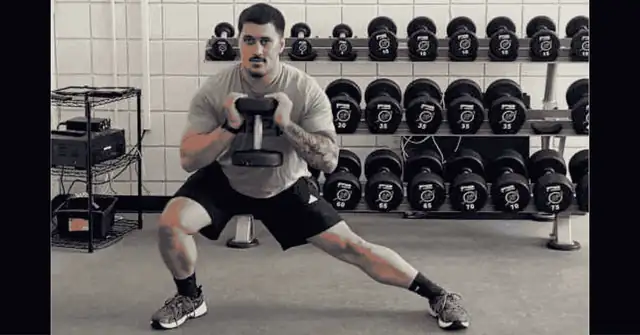
This article evaluates ankle mobility using the tools we have available, specifically the Messier squat. The Messier squat is a unique closed-chain movement where an athlete brings their hips down and shifts from side to side, targeting the tissue of the lower body in the frontal plane.
Video: Example of a body weight Messier squat
Before getting into the use of the Messier squat in an athlete evaluation, we can first discuss a holistic approach to a lower-body evaluation. It has become fairly common knowledge that other areas of the body, most commonly the ankle and the hip, can cause issues at the knee.

Image: Athletes performing a barbell overhead squat
When approaching an evaluation, I start with the overhead squat to guide my direction. When doing an overhead squat, if an individual has an excessive forward lean in the torso, heels coming up, or foot flattening, turning out, then those are indicators that the lower leg may be responsible for the dysfunction showing up in the squat. You can also observe these issues in other weight room instances, especially under higher loads. On any squat pattern, you may observe these issues in the ankle/foot. If an athlete is doing a moderately heavy squat, then you may notice feet flatten, or an excessive forward lean at the torso, or a small amount of heels rising off the ground. I have also noticed feet flattening on trap bar deadlifts. If you work with a high volume of athletes and don’t have time to perform a baseline movement assessment and plan on incorporating some kind of squatting pattern in their training, then this could be a tool for understanding if they have any lower-body movement patterns that call for further screening. If the athlete is unable to find the positions after providing cues on a traditional squat pattern, I would be willing to bet that the same issues will show up in a much more significant way during an overhead squat assessment and likely more so when screening the individual joints in question. The quick way to confirm the analysis is to block off/elevate the individual’s heels. If elevating the heel clears up the movement issues, then you can be fairly certain the lower leg is creating the dysfunction.

Image: Comparison of an athlete squatting with and without the heels elevated to compare knee valgus – source: Bell, D. R., Oates, D. C., Clark, M. A., & Padua, D. A. (2013). Two-and 3-dimensional knee valgus are reduced after an exercise intervention in young adults with demonstrable valgus during squatting. Journal of athletic training,48(4), 442-449
An evaluation can and probably should include a mobility test for ankle dorsiflexion, plantar flexion, and inversion and eversion. These will likely show up as a lack of range of motion and can be a good indicator of what tissue needs attention. It is worth screening the knee for flexion and extension, and screening the hip for flexion, extension, internal rotation, and external rotation as a precaution and to understand the individual’s biomechanics.
An evaluation can and probably should include a mobility test for ankle dorsiflexion, plantar flexion and inversion and eversion, says @Graham Sokol Share on XUsing Pain as an Indicator
Pain in joints can indicate what tissue needs attention or what biomechanical movement is causing the pain. If a person has pain in the ankle or the knee that has gone unidentified by PT, AT, or the coach’s previous evaluations, then these observations can serve as tools to understand the individual circumstances and make adjustments based on findings.
For example, if a movement (goblet squat, back squat, front squat, single leg squat, etc.) is causing pain in the knee or ankle or spine, it is a good idea to block off the ankle with a slant board and see what its effects are on the pain and biomechanical positions. What you are doing here is artificially giving the athlete a greater range of motion in closed-chain dorsiflexion. If this clears the pain, then it would be a good idea to collaborate with a physical therapist, chiropractor, or athletic trainer to address this range of motion problem. Overactive tissue in the posterior lower leg is likely causing the restriction. Guidance on self-mobilization with a roller, or soft tissue device and the athlete can also perform static or dynamic stretches, but be cautious of stepping into other departments’ areas and operate within your scope of practice. I would never recommend a strength coach putting their hands on an athlete under any circumstances, especially not for soft tissue work, unless you are a dual practitioner (AT, DPT, LMT, DC, etc.).
Video: Lateral view of bodyweight Messier squat
If a loaded lateral movement (lateral lunge, Messier Squat, etc.) is causing pain in the ankle, knee, or back, then implement a different protocol. The Messier squat brings the ankle into dorsiflexion in a less extreme position than a sagittal plane squat, but it brings that ankle into much greater ranges of inversion and eversion than a sagittal plane squat. If pain only occurs with loaded lateral movements, then it is likely not an issue of dorsi and plantar flexion but of inversion and eversion. Taking the side that is experiencing pain and putting the athlete in a greater range of inversion or eversion will either make pain worse or eliminate pain, based on which movement their lack of range is in. Using a slant board to put the ankle in a fabricated range of inversion and/or eversion in a similar way to how we used the slant board with a traditional squat pattern to screen the ankle’s involvement will tell us if the ankle needs work on the tissues related to inversion and eversion.

Image: Example of an athlete using a slant board to bias the foot into inversion and eversion
Using the Messier Squat for Ankle or Knee Pain
We typically see that pain in the ankle or knee only presents on one side of the body. While it would be more thorough to evaluate both sides to get a greater context of the individual, it is likely something that is only an issue on one side. I have especially noticed this in return to play for knee/ankle injuries. Everything feels good until they move in the frontal plane and realize lateral movements present pain in the area of concern. Using the Messier squat as a movement screen could be useful for individuals with chronic ankle sprains and/or those who experience knee pain with lateral movements. Most of the time, if pain is occurring during a lateral movement, putting the affected side in either inversion or eversion will clear pain and/or movement issues.
The way I teach the Messier squat for this function:
Feet
Stay flat to the ground during the entire movement.
Knees
90-100 Degrees of knee flexion to almost full extension.
Hips
Stay low the entire time.
Torso/Shoulders
Upright torso position.
Head
Ear in line with the shoulder or just slightly in front.
Video: Lateral view of loaded Messier squat
Note: Many allow for excessive movement in the Messier squat by allowing the foot with less load on it to rotate up towards the sky and come off the ground. I find this to be less beneficial for using the movement as an evaluation. Often, when this happens, the torso will drop and/or rotate. The hip will externally rotate, and the range of motion of the more loaded leg will have a slightly greater range of motion. Since I mostly train larger teams, I tend to lean into weight room movements with fewer moving parts to create consistency and to run a smoother session. Having both feet on the ground allows for consistency of evaluation by standardizing this movement.
Note 2: It is important to view the movement from an anterior view and a lateral view at least. Posterior doesn’t seem necessary, but it could be given the specifics of the case.
Video: Anterior view of loaded Messier squat
Two ways to implement these pieces of information:
- Using a movement screen and addressing any issues is the better option and allows for a more permanent solution. However, it also takes a lot more time and dedication from the athlete and practitioner. Fixing the moment strategy by addressing the restricted tissue and strengthening the weakened tissues will allow the athlete to move without restriction through the required ranges of motion and no longer cause biomechanical faults and or pain.
- The simple and easy approach is to leave the problem unaddressed, but to get the athletes out of poor movement and or pain. Just continue to use a slant board while doing movements that require ankle mobility that are deficient. Although not the ideal solution, it will keep the athlete out of a poor position and pain while in the weight room.
Cheat Sheet

Image: Chart showing what tissue in the lower extremity is likely causing mobility deficits
Final Thoughts
Movement issues can be multifactorial and complicated to understand. I have noticed that many times changing ankle position resolves biomechanical faults and the pain experienced with certain movements, but there are other cases where it may reduce the biomechanical glitch or ease the pain without fully fixing either one. This would indicate that there is more than one issue at hand and would warrant further investigation upstream. The other consideration is with athletes that have a young training age or are new to the weight room. I would not be quick to jump to conclusions when using loaded movements as a primary assessment technique. Their limited exposure to training will likely leave them less than skilled enough to know where the body should be in time and could allow for some faults that could be coached out fairly quickly.
Note: All pictures and videos show people wearing shoes. This can be fine, especially if it feels very clear that you’re on the right path. It is always better to take the shoe off and see what the foot is doing during these movements.

