
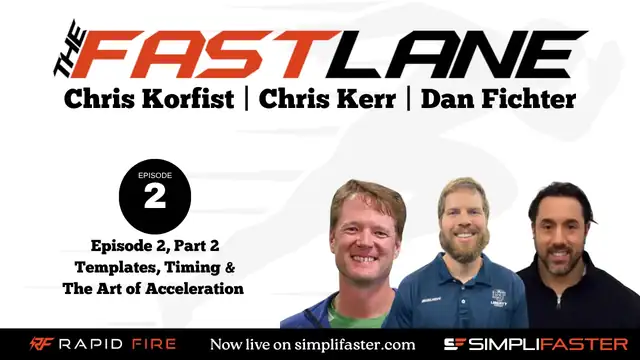
The Fast Lane Episode 2, Part 2



Published: October 18, 2025 | Last Updated: June 9, 2026
Episode 2, Part 2 of The Fast Lane dives deep into the evolution of training templates & how great coaches move from simple early-career programs to refined, adaptive systems built around speed, neural readiness and longevity.
Hosts Chris Kerr, Chris Korfist, and Dan Fichter break down the principles that guide year-round planning, from in-season football to spring and winter track. What begins as a conversation on weekly templates unfolds into a masterclass on movement, coordination, and coaching evolution.
Key Topics
From the Early Days to Smarter Templates
- Korfist, Fichter, and Kerr reflect on their first training systems — bodybuilding splits, Husker Power, and overspeed bungee cords that left battle scars.
- Why early mistakes shaped their understanding of what actually works in performance training.
Year-Round Planning that Works
- How to structure the training calendar for football in the fall, indoor track in the winter, and outdoor track in the spring.
- Why acceleration is the foundation — and how the best programs blend it with targeted recovery and neural stimulation.
- How to maintain strength and movement quality all season without burning athletes out.
Strength, Isometrics & Neural Recovery
- How extreme yielding isometrics build resilient athletes in- and off-season.
- Fichter’s six-station “neural recovery” circuit: dorsiflexion glides, infinity walks, barefoot acceleration, balance perturbations, rebound pushups, and splayed walks.
- The art of keeping athletes neurologically sharp while preserving their nervous-system health.
Acceleration vs. Max Velocity
- Why acceleration is the deciding factor in sport performance — and why max-velocity work should be micro-dosed.
- The biomechanics of lean: getting your “heart over your hips” and your mass in front of your engine.
- Drills that connect the weight room to the field through forward lean, coordination, and posture under load.
Profiling, Force-Velocity & Data Feedback
- How Korfist uses 1080 Motion data to evaluate horizontal force, Newtons/kg, and RF Max.
- How Fichter applies timing gates and change-of-direction tests to measure acceleration quality.
- Using data as a feedback loop — and knowing when to rely on your coaching eye over the metrics.
As always make sure you stream this on Spotify, Apple Podcasts or right in the video above!

