
How to Increase Sprint Speed: Ken Clark on Three Trainable Qualities


Summary
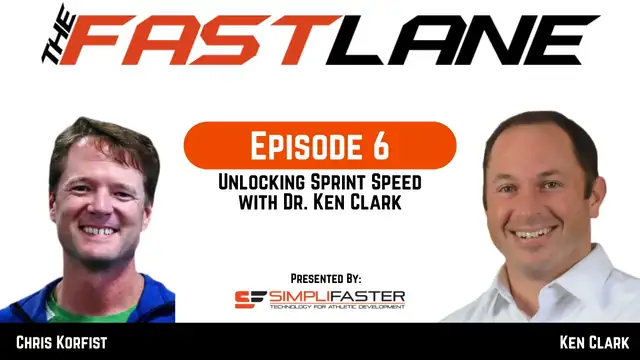
In this episode of The Fast Lane Podcast, Chris Korfist interviews sprint biomechanics expert Dr. Ken Clark about the key qualities that drive sprint speed, including angular velocity, force application, and stiffness. They also discuss why fundamentals like sprinting and plyometrics remain essential for developing faster athletes.
Based on Episode 6 of The Fast Lane, a conversation between host Chris Korfist and Dr. Ken Clark.
Ask most people how to increase sprint speed and you get a list of exercises. Korfist opened this one differently, asking Dr. Ken Clark which qualities can actually be changed, and the answer is a short, specific list with a time frame attached. What follows is a working model for where sprint speed comes from and, just as usefully, where Clark has changed his own mind.
Key Takeaways
- Three qualities drive top speed. Thigh angular velocity, vertical force application, and stiffness.
- All three are trainable. Not inside one session, but across a 12 to 16 week block or a career.
- Technical models have bandwidth. Clark’s view changed: athletes run fast on visibly different models.
- Big quads are not the goal. Knee extensors big enough not to collapse, with a genuinely strong hip.
- The hip is under-trained. Clark thinks it is the most commonly neglected area off the track.
The three qualities that can be changed
Clark’s answer is unusually concrete, and the caveat about timescale is part of the answer rather than a hedge.
Three most important qualities that are just so fundamental to sprinting, especially top speed: thigh angular velocity, vertical force application or rate of force, and stiffness. And I think all three of those can be changed. Maybe not right away within the context of one training session. But certainly over the course of a 12-week block, a 16-week block, and then certainly over the course of an athlete’s career.
Asked what actually trains them, he refuses to make it complicated, and flags that the honest answer sounds like a dodge.
Just the basic, I think, doing high-intensity sprints along with the plyometrics. And that’s such a cop-out answer, because there’s no single exercise. I think just doing the basics is gonna help all three of those.
Where Clark changed his mind on technical models
The most interesting part of the conversation is Clark revising a position, which he dates to the last three to five years. The revision is not that technique stops mattering, but that a single rigid model is the wrong expectation.
One thing we found from our research is that there’s definitely some different models where athletes can still run fast. One thing I’ve seen even at the elite level is that there’s some variation in technical models.
He is careful not to let that collapse into “technique does not matter,” because every coach is teaching toward some model whether they admit it or not.
It’s important certainly to coach to a technical model, whether that’s more of a track and field frontside model or even more of a team sport model. Whatever you do, you’re always coaching towards some technical model. But it’s important to understand that there’s gonna be some variability, some acceptable bandwidth in that technical model, just based on the athlete you’re working with.
Not all hypertrophy helps
Clark makes a distinction that has direct programming consequences: muscle in the wrong place can work against sprinting. He raises the research carefully, hedging his own recall of the details.
There’s a fair amount of research about non-functional hypertrophy when it comes to sprinting. There’s one or two studies that look at quadricep cross-sectional area as it relates to iliopsoas cross-sectional area, and I could be missing a few of the details here. But essentially, you don’t want huge quads and small hip flexors. That’s not good for being able to reverse the thighs.
His prescription follows directly from that: build the knee extensors to a sufficiency standard and the hip to a performance standard.
You want the knee extensors just big enough so that you’re not collapsing at the knee, but you need the musculature surrounding the hip to be functionally strong.
The comparison he uses to make it concrete is track cycling, where the same big-quad physique is genuinely appropriate because the demands are different.
They’ve got huge quads, because the knee extensors are so much more important, relatively speaking, from a cycling standpoint. But not the case from a sprinting standpoint. Still important, but not as important as what’s going on at the hip and probably the ankle.
The area most coaches skip
Asked what he sees missing when he watches people train, Clark gives an answer he acknowledges is not universally shared.
Not everybody agrees with this per se, but I always think that the hips are vastly under-trained off the track.
He pairs it with a balance argument that is easy to overlook. Even though hip flexion during the gait cycle is reflexive rather than consciously driven, he still wants the anterior chain trained deliberately so the athlete stays balanced rather than only loading the back side.
Data Points and Metrics
| Quality or claim | Detail | Context |
|---|---|---|
| Quality 1 | Thigh angular velocity | How fast the thigh rotates; central to top speed. |
| Quality 2 | Vertical force / rate of force | Force application into the ground, and how quickly it is applied. |
| Quality 3 | Stiffness | Resistance to collapse on ground contact. |
| Time to change them | 12 to 16 week block | Not within a single session; also across a season and a career. |
| Primary training means | Sprints + plyometrics | Clark says the basics move all three; no single exercise does it. |
| Hypertrophy target | Hip over quad | Knee extensors just big enough to avoid collapse; hip musculature functionally strong. |
Frequently Asked Questions
What qualities determine sprint speed?
Clark names three as fundamental, especially at top speed: thigh angular velocity, vertical force application or rate of force, and stiffness. He considers all three trainable rather than fixed.
How long does it take to increase sprint speed?
Longer than a session. Clark frames meaningful change over a 12 to 16 week block, and larger change across a season or an athlete’s whole career.
What exercises increase sprint speed?
Clark declines to name a single exercise and says the basics, high-intensity sprinting plus plyometrics, move all three qualities. He acknowledges this sounds like a cop-out answer but stands by it.
Is there one correct sprint technique?
No. Clark’s view changed over the last three to five years: research and elite observation show athletes running fast on different technical models. He still coaches toward a model, but expects an acceptable bandwidth around it based on the athlete.
Do bigger quads make you faster?
Not necessarily. Clark points to research on non-functional hypertrophy, arguing you want knee extensors just big enough to avoid collapsing at the knee while the hip musculature is functionally strong. He contrasts sprinting with track cycling, where large quads genuinely suit the demand.
Related on SimpliFaster
- 40-Yard Dash Training: Korfist and Fichter on the Real Numbers
- Korfist and Fichter on Foot Strength and Wave Sprints
- Ground Contact Time: Joseph Coyne on Speed Training
- How to Run Faster: Jeff Moyer on Mechanics and Dosage
About the Speakers
Dr. Ken Clark is a sprint biomechanics researcher and one of the most cited voices in applied speed research, known for work on ground force application and the mechanical determinants of top speed. Korfist introduces him on air as the person pushing speed development hardest in the research world.
Chris Korfist is a longtime high school track and football coach, founder of Slow Guy Speed School, a co-founder of the Track Football Consortium, and a host of The Fast Lane.

