
Building the Engine: Aerobic Base Building for TSAC
In this Article
- Introduction: The Misunderstood Engine for Tactical Performance
- Why Does Aerobic Fitness Improve Strength Outcomes?
- Factor 1: Recovery Between Sets
- Factor 2: Mitochondrial Efficiency
- Factor 3: Work Capacity
- What Conditioning Methods Transfer Best to Tactical Populations?
- Method 1: Zone 2 Aerobic Development
- Base Building and Intensity Phases: Putting It Into Practice
- Weeks 1 - 4: Base Building Phase
- Weeks 5 - 8: Transition Phase
- Weeks 9 - 12: Intensity Building Phase
- Visual Framework: The Tactical Aerobic System
- Example Weekly Aerobic Programming for Tactical Athletes
- Eight Week Aerobic Base Progression Example
- Common Mistakes in Tactical Aerobic Training
- Bringing It All Together
- References

Summary
Strength, power, and speed often dominate the conversation in tactical strength and conditioning, leaving aerobic capacity overlooked. However, for military personnel, law enforcement officers, and firefighters, real-world performance relies heavily on the ability to repeatedly execute high-intensity tasks with incomplete recovery. Building a strong aerobic base isn’t about turning tactical operators into endurance athletes; rather,…
Introduction: The Misunderstood Engine for Tactical Performance
Strength, power, and speed dominate most conversations in strength and conditioning. Tactical athletes train to sprint faster, lift heavier loads, and develop explosive power because these qualities are highly visible and easy to measure. Yet the ability to repeatedly produce force, recover between efforts, and sustain operational work over extended periods depends heavily on a less glamorous quality: aerobic capacity.
In tactical populations (including military personnel, law enforcement officers, and firefighters) performance rarely occurs in isolated maximal efforts. Instead, operators must perform repeated high-intensity tasks separated by incomplete recovery. Sprinting, climbing, dragging equipment, moving under load, and maintaining situational awareness all occur in environments where fatigue accumulates quickly. Aerobic development supports these demands by improving recovery kinetics, enhancing mitochondrial efficiency, and expanding overall work capacity.
For coaches working in Tactical Strength and Conditioning (TSAC), building an aerobic foundation is not about turning tactical athletes into endurance athletes. In my experience working with tactical populations, I’ve seen this play out repeatedly. Athletes who chase strength and intensity without building an aerobic base tend to break down faster, recover slower, and struggle to maintain output over time. Instead, it is about developing a physiological engine that allows strength and power to be expressed repeatedly during real-world tasks when lives are on the line.
Why Does Aerobic Fitness Improve Strength Outcomes?
Many strength coaches initially view aerobic training as competing with strength development. Early research on concurrent training suggested that combining endurance and resistance work could interfere with strength gains (Hickson, 1980). However, more recent evidence shows this interference effect is highly context-dependent and often overstated. Large meta-analyses demonstrate that concurrent aerobic and strength training does not meaningfully impair muscle hypertrophy or maximal strength development when appropriately programmed.
In fact, concurrent training consistently produces greater strength and hypertrophy adaptations than endurance training alone, while remaining comparable to strength-only training in most outcomes. More importantly, aerobic development enhances several underlying physiological qualities that directly support strength performance. Improvements in aerobic capacity increase recovery between sets and sessions, enhance fatigue resistance, and allow for greater total training volume over time. These adaptations create a more favorable environment for long-term strength and hypertrophy development. While some studies report a small reduction in muscle fiber hypertrophy or explosive power with concurrent training, these effects are minimal and influenced by programming variables such as modality, volume, and sequencing.
For example, interference effects are more likely when coaches use high volumes of running, whereas lower-impact modalities such as cycling or properly structured interval training minimize these effects. Newer research suggests that specific forms of aerobic training such as high-intensity interval work can be integrated in a way that maintains or even enhances strength and muscle adaptations within concurrent programs.
Taken together, the current body of literature suggests that aerobic training is not a competing stimulus, but rather a complementary one. When programmed correctly, it enhances the athlete’s ability to recover, sustain output, and tolerate higher workloads, which are key drivers of strength and hypertrophy adaptation, particularly in tactical populations. Three major factors influence recovery:
- Rest Between Sets
- Mitochondrial Efficiency
- Work Capacity
Factor 1: Recovery Between Sets
When I first started working in this setting, this was one of the biggest gaps I saw. Athletes were strong and capable, but their ability to recover between efforts just wasn’t there. So, we had to utilize a better way to recover between sets. A well-developed aerobic system helps you restore phosphocreatine faster between high-intensity efforts. That matters because phosphocreatine is what fuels your explosive work, like sprints, heavy lifts, jumps, and short bursts of effort. Once it’s depleted, your ability to produce force drops off quickly, and how fast you can bring it back determines how well you perform on the next set or rep. You can see this clearly in the weight room. I’ve worked with athletes who hit a heavy set, but by the second or third effort their output drops off significantly. Once we build their aerobic base, that drop-off becomes much smaller and session quality improves almost immediately.
Your aerobic system is what drives that recovery. When it’s built up, you’ve got better oxygen delivery, more efficient energy production, and faster restoration of those high-energy stores. The result is simple. You recover quicker between sets, your output stays higher, and you don’t fall off as hard as the session goes on.
Now from a training standpoint, this is huge. You get more quality reps, you can handle more total work, and you stay consistent throughout the entire session. Over time, this adds up to better strength gains, more muscle, and better overall performance.
So, what does the research say? Research by Tomlin and Wenger (2001) demonstrated that individuals with higher aerobic fitness recover more rapidly between repeated high-intensity efforts. For strength coaches, this means athletes with better aerobic conditioning often tolerate higher workloads during training including under the barbell and on the field/track.
To summarize, this training has directly influenced:
- recovery between strength sets
- repeated sprint ability
- overall training session quality
Now what about looking at our next factor, mitochondrial efficiency? Why does it work and how can we adapt it to tactical environments?
Factor 2: Mitochondrial Efficiency
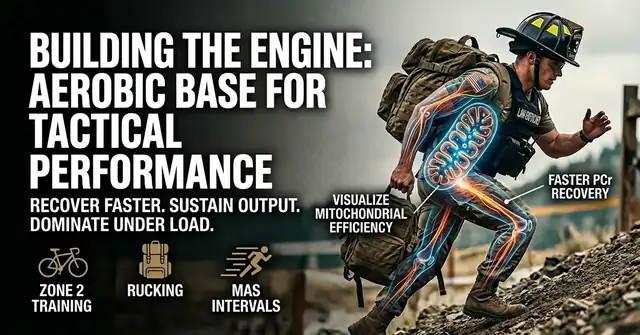
Aerobic training increases mitochondrial density and oxidative enzyme activity within the muscle tissue. These adaptations improve the efficiency of energy production and enhance the body’s ability to generate ATP during repeated muscular contractions. This ultimately allows athletes to sustain higher outputs for longer, recover faster between efforts, and maintain performance across repeated bouts of work. In simple terms, we get a bigger and more efficient engine that can run for longer! I like to explain this to athletes as building a bigger engine that doesn’t redline as quickly. Once they understand that, it usually clicks why we’re spending time on lower-intensity work.
In tactical environments, these adaptations support performance during tasks such as:
- prolonged load carriage
- repeated sprinting
- sustained operational work over hours or days
Now let’s put that into practice. For the examples above:
- prolonged load carriage example: build this with longer zone 2 rucks or incline walks, gradually increasing duration and load while keeping heart rate controlled
- repeated sprinting example: use aerobic intervals or tempo work to improve recovery between efforts, allowing athletes to maintain speed across multiple bouts
- sustained operational work over hours or days example: develop this through consistent low-intensity aerobic work paired with higher frequency training, improving overall work capacity and durability
Rather than competing with strength development, aerobic adaptations often improve the athlete’s ability to sustain strength and power outputs over longer periods. In simple terms, you build a bigger and more efficient engine that doesn’t gas out when things get hard. And in tactical settings, that’s exactly what shows up when you’re under load, moving repeatedly, and still expected to perform hours into the job. Now what about looking at our next factor, work capacity. How can we use it for TSAC?
Factor 3: Work Capacity
Work capacity can be broadly defined as the ability to perform and recover from repeated bouts of work. In tactical settings, this is one of the most important qualities you can develop, because the job rarely asks for one maximal effort. It asks for consistent output repeatedly with limited recovery. In tactical settings, I’ve seen this be one of the biggest separators for people in all high-performing units across the globe. The athletes who can keep showing up and performing across long days are almost always the ones with the best aerobic foundation.
A stronger aerobic base is what allows this to happen. When aerobic fitness is higher, athletes can tolerate more total work without breaking down, both within a session and across a full training week. This directly impacts strength and conditioning outcomes. Athletes with better work capacity typically show up more consistently, recover faster between sets, and can handle higher overall training volumes without excessive fatigue.
In simple terms, they can do more work, more often, and at a higher quality.
In tactical environments, this shows up in situations such as:
- long training days with multiple physical demands
- repeated high-intensity efforts with limited recovery
- extended operations where fatigue continues to build over time.
Now let’s put that into practice. For the examples above:
- long training days example: build this with higher frequency training weeks, combining lifting, aerobic work, and low level movement without overloading any single session
- repeated high-intensity efforts example: use mixed modal conditioning (sleds, carries, intervals) with incomplete rest to train the ability to recover and go again
- extended operations example: develop this through consistent zone 2 work and gradual increases in total weekly volume, building durability over time
The key is that work capacity is not just about doing more work, it is about being able to recover from it and keep showing up at an elevated level. When work capacity is built the right way, it allows everything else to improve. Strength sessions get better, conditioning becomes more effective, and athletes can actually express what they’ve trained without constantly feeling run down. For tactical populations, this is what separates those who can perform once from those who can perform all day, every day, when it counts. Now that we have gone over the three main qualities, we need to discuss what methods transfer the best when working with tactical athletes.
What Conditioning Methods Transfer Best to Tactical Populations?
Not all conditioning methods translate well to tactical performance. The goal is not simply improving endurance but developing conditioning that supports operational demands.
Three methods consistently show strong transfer. They are:
- Zone 2 Aerobic development
- Maximal Aerobic Speed (MAS) Intervals
- Rucking
Method 1: Zone 2 Aerobic Development
Zone 2 training occurs at moderate intensities where athletes rely primarily on aerobic metabolism while maintaining continuous work.
Typical characteristics include:
- heart rate approximately 60–70% of maximum
- sustainable conversational pace
- continuous efforts lasting 30–60 minutes
This type of training drives mitochondrial adaptations, improves fat oxidation, and enhances recovery capacity.
Common modalities include:
- incline walking
- cycling
- rowing
- light rucking
Zone 2 training forms the backbone of aerobic base development because it provides strong physiological benefits while keeping fatigue low. It builds the engine without constantly breaking the athlete down. Over time, it improves mitochondrial density, oxygen delivery, and overall efficiency, helping athletes recover faster, handle more training volume, and stay consistent week to week.
However, while Zone 2 builds the foundation, it does not fully prepare athletes for higher-intensity demands. Once the base is in place, we can start introducing more demanding work that pushes the system further. This is where Maximal Aerobic Speed (MAS) training comes in.
Method 2: Maximal Aerobic Speed (MAS) Intervals: Maximal Aerobic Speed (MAS) intervals target aerobic power by training at or near the fastest pace an athlete can sustain while still relying primarily on the aerobic system. In simple terms, it’s the speed associated with an athlete’s max oxygen uptake, not an all-out sprint, but a hard, repeatable effort.
These intervals are typically short, structured bouts of work with controlled rest, allowing athletes to accumulate time at a high aerobic intensity without completely fatiguing. This improves running efficiency, increases the ceiling of the aerobic system, and teaches athletes to maintain speed and output across repeated efforts.
Examples include:
- 15 seconds on / 15 seconds off
- 30 second efforts at MAS pace
- short shuttle repeats
MAS intervals provide a higher-intensity stimulus while still targeting the aerobic system, but they also come with a higher strain on the central nervous system compared to lower-intensity work. From a coaching standpoint, this is where I see people make mistakes. It’s easy to overuse these because they feel productive, but if they’re not balanced with lower-intensity work, fatigue builds quickly. Make sure to utilize the zone 2 training methods in method 1 to assist in offsetting this fatigue.
Method 3: Rucking : Load carriage is a fundamental requirement for many military populations. Rucking builds tolerance to external load, reinforces posture under equipment, and develops the trunk and hip stability needed to move efficiently under stress. It is one of the most specific tools we have for preparing tactical athletes for real-world demands.
Benefits of rucking include:
- occupational specificity
- load tolerance
- trunk and postural endurance development.
However, the downside is that rucking comes with a real orthopedic cost. Research from Dr. Rob Orr consistently shows that load carriage is a major contributor to injury in military populations, with studies reporting that approximately one third of soldiers experience a load carriage-related injury, most commonly affecting the lower extremities. Excessive load, poor progression, and accumulated fatigue often drive these injuries rather than the task itself. Once injured, the likelihood of re-injury during future load carriage tasks also increases, creating a cycle that limits both readiness and performance.
Because of this, effective programs do not rely on rucking alone to build aerobic capacity. Dr. Orr’s work emphasizes that load carriage should be used strategically within a broader training system that includes strength development and aerobic conditioning. When athletes have a stronger aerobic base and better overall physical preparation, they demonstrate improved load carriage performance with a reduced injury risk.
So the goal is not to ruck more. It is to ruck better.
Coach’s Note: How to Make Rucking Suck Less (and Actually Work)
If you want rucking to improve performance instead of breaking people down, you need to control the variables that actually drive stress.
- don’t just add weight: load is the primary driver of strain, and excessive loading is strongly associated with increased injury risk, so progression should prioritize duration, terrain, and pace before increasing external load
- progress gradually: rapid increases in load or distance are one of the biggest contributors to load carriage injuries, so exposure needs to be built over time, not forced in a single session
- use terrain and pace: hills and varied terrain can increase the physiological demand without the same orthopedic cost as simply adding more weight
- build the base outside of rucking: aerobic fitness and strength have both been shown to improve load carriage performance, meaning you can get better at rucking without constantly rucking
- space it out: treating rucks as high-stress sessions and separating them from heavy lower-body training helps manage fatigue and maintain quality
Putting Rucking Into Practice: A better approach is to use rucking in controlled doses to build specificity and tolerance to load, while developing the majority of aerobic capacity through lower-impact methods. Instead of overwhelming athletes with excessive volume or weight, coaches should build load exposure progressively over time. This allows athletes to gain the benefits of rucking while minimizing unnecessary wear and tear, keeping them healthier and more consistent in training. The goal is not to avoid rucking, but to respect it. When programmed correctly, it builds durability, confidence under load, and real-world performance. When overused, it becomes one of the fastest ways to break tactical athletes down, delaying mission objectives and driving up medical costs for the units they serve.
Base Building and Intensity Phases: Putting It Into Practice
Early training phases focus on building the aerobic base that everything else sits on. This is where you develop the engine before pushing intensity. Training during this phase is simple and consistent, with more Zone 2 work, longer steady sessions, and gradual increases in duration over time. The goal is not to crush the athlete, but to build capacity. When base building is done well, athletes recover faster, handle more volume, and are better prepared for harder training later in the cycle.
Once that base is built, training can shift toward higher-intensity work. This is where you start layering in intervals, faster efforts, and more demanding conditioning sessions. The goal is to teach the athlete to produce and repeat higher outputs without falling off. Because the aerobic base is already in place, athletes can recover between efforts and maintain quality across sessions. Instead of breaking down, they can push intensity while still progressing strength, power, and overall performance. See the practical outlines and charts below:
Weeks 1 – 4: Base Building Phase
|
Focus |
Application |
|---|---|
|
Aerobic Development |
High Zone 2 volume |
|
Session Structure |
Longer continuous efforts |
|
Progression |
Gradual increase in duration |
|
Strength Training |
Low to moderate intensity |
|
Goal |
Build capacity and improve recovery |
Weeks 5 – 8: Transition Phase
|
Focus |
Application |
|---|---|
|
Aerobic Maintenance |
Maintain Zone 2 work |
|
Conditioning |
Introducing tempo work and light intervals |
|
Strength Training |
Begin increasing intensity |
|
Volume |
Slight reduction in total volume |
|
Goal |
Bridge base to intensity |
Weeks 9 – 12: Intensity Building Phase
|
Focus |
Application |
|---|---|
|
Conditioning |
Higher intensity intervals |
|
Specificity |
More task-specific work |
|
Aerobic Work |
Maintain base with lower volume |
|
Strength Training |
Peak strength and power |
|
Goal |
Maximize performance output |
Visual Framework: The Tactical Aerobic System
Aerobic development can be viewed as the engine that supports repeated high-intensity performance.
|
Physiological Adaptation |
Tactical Benefit |
|---|---|
|
Increased mitochondrial density |
Improved energy production |
|
Increased capillary density |
Better oxygen delivery |
|
Faster phosphocreatine recovery |
Faster recovery between efforts |
|
Improved fat oxidation |
Glycogen preservation during long tasks |
|
Increased cardiac output |
Sustained performance under load |
While strength and power represent peak performance outputs, aerobic capacity determines how often those outputs can be repeated.
Example Weekly Aerobic Programming for Tactical Athletes
|
Day |
Training Focus |
Conditioning Method |
Intensity |
Duration |
|---|---|---|---|---|
|
Monday |
Strength + Aerobic Base |
Zone 2 bike |
60–70% HRmax |
30–40 min |
|
Tuesday |
Conditioning |
MAS intervals |
High |
12–16 min |
|
Wednesday |
Strength |
Light aerobic recovery |
Low |
20–30 min |
|
Thursday |
Aerobic Development |
Zone 2 ruck |
60–70% HRmax |
40–60 min |
|
Friday |
Strength + Work Capacity |
Short shuttle intervals |
High |
10–12 min |
|
Saturday |
Aerobic Base |
Row or bike |
60–70% HRmax |
30–45 min |
|
Sunday |
Recovery |
Walking / mobility |
Very low |
— |
Eight Week Aerobic Base Progression Example
|
Week |
Zone 2 Sessions |
MAS Intervals |
Ruck Volume |
Total Aerobic Time |
|---|---|---|---|---|
|
1 |
2 × 30 min |
8 × 15s |
— |
60 min |
|
2 |
2 × 35 min |
10 × 15s |
— |
70 min |
|
3 |
2 × 40 min |
10 × 20s |
30 min |
90 min |
|
4 |
2 × 45 min |
12 × 20s |
30 min |
100 min |
|
5 |
2 × 45 min |
10 × 30s |
40 min |
110 min |
|
6 |
2 × 50 min |
12 × 30s |
45 min |
120 min |
|
7 |
2 × 50 min |
10 × 30s |
50 min |
125 min |
|
8 |
2 × 55 min |
12 × 30s |
60 min |
140 min |
Common Mistakes in Tactical Aerobic Training
Mistake 1: Conditioning Used as Punishment: I’ve seen this a lot in tactical settings, where coaches use conditioning as punishment instead of a tool. Sessions designed purely to exhaust athletes may create fatigue, but they rarely drive meaningful physiological adaptation. Over time, this approach leads to burnout, inconsistent performance, and limited progress. Aerobic development should be intentional, progressive, and aligned with the overall training goal, not used as punishment for poor performance or effort.
Mistake 2: Too Much Middle Intensity Work: Most programs I come across tend to live in this middle zone, and it’s one of the biggest reasons progress stalls. Many programs fall into the trap of constantly training at moderate intensities, which are hard enough to create fatigue but not targeted enough to drive optimal adaptation. Research on endurance training consistently shows that effective programs emphasize lower-intensity work for base development, combined with strategic high-intensity sessions to improve performance (Seiler & Tønnessen, 2009). When most training lives in the middle, athletes accumulate fatigue without maximizing either recovery or high-end output, limiting both aerobic development and overall performance.
Mistake 3: Not Getting Off Your Feet: A third mistake is never getting off the feet. Tactical athletes already accumulate a high amount of stress through running, rucking, and standing throughout the day, and constantly layering more impact-based conditioning on top of that only increases injury risk and fatigue. Programs that fail to incorporate non-loaded or low-impact modalities miss an opportunity to build aerobic capacity while reducing wear and tear. Using tools like biking, swimming, or other non-loaded conditioning methods allows athletes to increase training volume, improve recovery, and continue developing their aerobic system without constantly beating up the joints.
Bringing It All Together
This article really comes down to one thing. Aerobic capacity is the base that everything else sits on. We broke down how it helps you recover faster between sets, keep your output higher, and handle more total work without falling off. We also showed how it supports strength and muscle instead of hurting it, and how things like Zone 2 work, intervals, and smart rucking all play a role when they’re programmed the right way.
From there, it’s about actually applying it. Build the base first, then layer in intensity. Keep it simple, stay consistent, and avoid the common mistakes that kill progress like turning conditioning into punishment, living in that middle-intensity zone, or just constantly beating your body up with impact work. Those are the things that sneak up and limit performance over time.
At the end of the day, this isn’t about making tactical athletes endurance athletes. It’s about giving them an engine that lets everything else show up when it matters. When the aerobic system is built right, strength lasts longer, recovery is faster, and performance doesn’t fall apart when fatigue hits. And in this world, that’s what actually matters.
Please reach out with any questions or if you would like to contact me to discuss everything strength and conditioning, coaching, business, etc. The best email to reach me is [email protected] or follow/direct message me on Instagram (Coach_Telegadas). Now get out there, get organized, and train hard!
References
Chen, Y., Feng, X., Huang, L., Wang, K., & Mi, J. (2024). Comparative efficacy of concurrent training types on lower limb strength and muscle hypertrophy: A systematic review and network meta-analysis. Journal of Exercise Science & Fitness.
Fyfe, J. J., Bishop, D. J., & Stepto, N. K. (2014). Interference between concurrent resistance and endurance exercise: Molecular bases and the role of individual training variables. Sports Medicine, 44(6), 743–762.
Hickson, R. C. (1980). Interference of strength development by simultaneously training for strength and endurance. European Journal of Applied Physiology, 45(2–3), 255–263.
Knapik, J. J., Orr, R., Pope, R., & Grier, T. (2015). Injuries and physical training in military populations. Sports Medicine, 45(6), 749–763.
Lundberg, T. R., et al. (2022). The effects of concurrent aerobic and strength training on muscle fiber hypertrophy: A systematic review and meta-analysis. Sports Medicine, 52, 2391–2403.
Orr, R. M., Johnston, V., & Coyle, J. (2015). Load carriage: Minimising soldier injuries through physical conditioning. Journal of Military and Veterans’ Health, 23(3), 31–38.
Orr, R. M., Pope, R., Johnston, V., & Coyle, J. (2014). Load carriage and its force impact. Australian Defence Force Journal.
Orr, R. M., Pope, R., Johnston, V., & Coyle, J. (2015). Soldier occupational load carriage: A narrative review of associated injuries. International Journal of Injury Control and Safety Promotion, 22(4), 388–396.
Schumann, M., Feuerbacher, J. F., Sünkeler, M., & Lundberg, T. R. (2022). Compatibility of concurrent aerobic and strength training for skeletal muscle size and function: An updated systematic review and meta-analysis. Sports Medicine, 52, 601–612.
Seiler, S., & Tønnessen, E. (2009). Intervals, thresholds, and long slow distance. Sportscience, 13, 32–53.
Tomlin, D. L., & Wenger, H. A. (2001). The relationship between aerobic fitness and recovery from high intensity intermittent exercise. Sports Medicine, 31(1), 1–11.
Wilson, J. M., Marin, P. J., Rhea, M. R., Wilson, S. M., Loenneke, J. P., & Anderson, J. C. (2012). Concurrent training: A meta-analysis examining interference of aerobic and resistance exercises. Journal of Strength and Conditioning Research, 26(8), 2293–2307.

