
Deadlift Technique: Justin Moore on Posture and Hamstrings

In this Article

Summary
Parabolic Performance coach Justin Moore on deadlift technique and posture: how the Postural Restoration lens changes the way you set up the deadlift and squat, so you load your hamstrings and glutes instead of grinding your lower back.
Based on Episode 78 of the Just Fly Performance Podcast, a conversation between host Joel Smith and strength coach Justin Moore.
Justin Moore’s deadlift technique starts somewhere most lifters never look: the position of the rib cage and pelvis before the bar ever moves. A coach at Parabolic Performance who built his approach around Postural Restoration Institute (PRI) principles, Moore has a simple explanation for a problem many strong people share, a back that keeps getting bigger while the hamstrings stay weak and tight. The fix, he argues, is not more hamstring exercises but a better setup, one that lets you load the muscles a lift is supposed to train. In this conversation he applies that lens to the deadlift, the squat, and how coaches cue.
Key Takeaways
- PRI is a lens, not a program. A couple of breathing drills, then a sharper eye on every lift.
- Position drives everything. Set the rib cage and pelvis first, and the limbs can finally move well.
- Tight, weak hamstrings usually mean an anteriorly tilted pelvis, not short muscles. Stretching will not fix it.
- Exhale to earn the zone of apposition. Getting the ribs down first builds real intra-abdominal pressure before you load.
- Let the knees travel forward. Keeping hamstring tension loads hamstrings and glutes instead of the lower back.
PRI is a lens, not a routine
People who know Moore for his PRI writing are often surprised how little of it appears in a training session. The value, he says, is not the drills themselves.
The biggest thing it’s done for me is it’s given me a lens through which to view all movement with a more discerning eye. It may constitute two to three activities of a couple breaths each, and then we’re moving on.
Everything after that is ordinary training, watched through a changed set of eyes. When Moore looks at a lift now, he is reading the foundation underneath the movement rather than just the movement itself.
Position first: the axial skeleton sets up the limbs
Moore’s organizing principle is that the proximal structures, the rib cage and pelvis, have to be positioned before the limbs can express clean movement. He borrows a door analogy to make it concrete.
Imagine opening and closing a door. If I move that door frame even an inch, the door slams into the wall and won’t open correctly, and no matter what you do to the hinges, it won’t change. You have to bring the frame back to where it needs to be. That’s what we’re looking at from a positional perspective.
The rib cage and pelvis are the frame; the hip and shoulder are the door. This is also where his idea of variability lives, which he is careful not to oversell. Variability is simply having movement options, and more is not always better.
A powerlifter or a 100-meter sprinter should not have a ton of variability. We need to decrease variability to increase specificity and drive performance. But if someone is stuck in the sagittal plane, thorax forward and pelvis forward, their frontal and transverse planes are locked.
Why your hamstrings feel tight and weak
The most relatable idea in the episode is Moore’s explanation for the hamstring that always feels tight yet never seems to work. The culprit is usually position, not length.
People walk around in an anteriorly tilted pelvic position with an eccentrically oriented hamstring, and they wonder why they can’t feel their hamstrings and why their hamstrings always feel tight. You can stretch that thing all you want, but really you’re taking an already stretched rubber band and pulling it apart even further.
A muscle held long sits past the length where it contracts well, so it is hard to feel and slow to fire. That reframes the fix: instead of stretching or piling on isolation work, restore the pelvis to a more neutral position so the hamstring can actually load.
Breathing and the zone of apposition
Breathing is how Moore changes that position, because respiration manages the pressure that stabilizes the trunk. The mistake he sees most is the big belly breath people take to brace.
If I take a huge belly breath that people think locks them into a good position, really I’m just driving everything forward. My thorax moves forward, my pelvis tilts, and I haven’t maximized intra-abdominal pressure. What I want is to exhale first, bring the rib cage down and back, and give myself a zone of apposition. Then when I breathe in with active abdominals, the pressure expands through the whole thorax and I have a strong canister to move through.
He has watched this open up range of motion fast. Teaching a stiff combine athlete to exhale with the abs, settle the ribs, and let the diaphragm do its job opened up shoulder and straight-leg-raise range in a couple of light sets, a change he attributes to pressure moving to a better place rather than to any stretching.
How he coaches the deadlift
All of this converges on the lift Moore leads with. His deadlift setup is built to load the posterior chain rather than the lower back.
When I coach a deadlift, I have people soften their knees, put their weight through the middle of the foot, and exhale to move their ribs down and find some abs. From that position I can eccentrically load their hamstrings, as opposed to a lot of people who grab the bar, arch hard, chest up, and go.
Softening the knees is a reach, he explains: pushing the knees forward a little lets the proximal structures shift back, which brings the pelvis toward neutral so the hamstrings are no longer pinned in a lengthened, non-contracting position. Once the athlete grips the bar, the internal work is over and he cues externally, pushing through the ground. The insight landed for him personally.
I kept thinking, why does my back always hurt after deadlifts, and why do all my athletes tell me all they feel is their back? I realized I was never loading those tissues to begin with. I was never putting the hamstrings in a position to eccentrically load and work as prime movers.
How he coaches the squat
The squat gets the same treatment, starting with a target that surprises coaches raised on “sit back” and “knees behind toes.” Moore wants the knees to travel.
If we don’t let the knees go forward and we don’t dorsiflex, that force has to go somewhere. It goes up the chain to where the hinge is happening more, the hips, and if an athlete doesn’t have enough hip flexion, the load goes to the lumbar spine. Then you’re combating that load with your erectors, and I don’t want erectors as prime movers in a squat.
He keeps a relatively vertical torso with the rib cage stacked over the pelvis, the full foot on the floor, and, crucially, tension in the hamstrings on the way down so the pelvis stays controlled. When athletes back-squat heavily out of position instead, he says, the erectors take over and hypertrophy into what he jokingly calls “second butt syndrome,” driving fake hip extension through the back. He is equally skeptical of reflexive “knees out” cueing, drawing a distinction coaches often miss.
Internal rotation and valgus are not the same thing. I want the knees to naturally hinge straight ahead over the middle of the foot. I’m not cuing in, I’m not cuing out. We’ve become very glute happy.
Rather than force a body-weight squat that looks clean, he often adds anterior load (a goblet squat, then a safety bar or front squat) because holding weight in front helps an athlete shift the center of mass back and sit down more vertically. He also notes that many cues we now teach as universal technique, chest up, big back, knees out, were originally a coach’s fix for one athlete’s specific fault, not the definition of how to squat.
Internal versus external cueing
Underneath both lifts is a question Moore is passionate about: when to have an athlete feel their body and when to let them go. His answer is to separate the two by phase.
The internal cueing, the biomechanical building stuff, has to live in the warm-up and the PT realm. Once it’s time to lift heavy things and move fast, it’s time to be goal-directed and externally cued, focused on pushing through the floor and moving the bar as fast as you can.
Loading an athlete with sensation and low-level motor control while they are trying to produce force, he argues, backfires, because the brain cannot generate a big output while it is busy monitoring exactly how the output is made.
If we’re running away from a lion as fast as we can, we’re certainly not thinking about how we’re doing it. We’re just focused on the external goal of moving as fast as we can.
So the internal, PRI-style work stays small and early, a few sets of a few breaths to set position, and then training becomes training. It is a deliberate correction to an industry that, in his view, has let motor-control detail creep in and take over the weight room.
Frequently asked questions
How do you deadlift without hurting your lower back?
Set position before you pull: soften and reach the knees slightly forward, put your weight through the middle of the foot, and exhale to bring the ribs down and find your abs. That shifts the pelvis toward neutral so the hamstrings and glutes can load, instead of the lower back absorbing the lift.
Why can’t I feel my hamstrings when I deadlift or squat?
Usually because an anteriorly tilted pelvis holds the hamstrings in a lengthened position where they contract poorly, so they feel both tight and weak. Moore’s fix is to restore pelvic position through setup and breathing rather than to stretch them or add more isolation work.
What is the zone of apposition?
It is the position, achieved by exhaling and bringing the rib cage down and back, where the diaphragm and abdominals can work together. From there an inhalation with active abs raises pressure through the whole trunk, creating a stronger, more stable “canister” than a forward-driving belly breath.
Should your knees go forward or past your toes when you squat?
In Moore’s view, yes. Blocking the knees from traveling forces the load up the chain to the hips and often the lumbar spine. He wants the knees to track naturally over the middle of the foot with a vertical torso so the hamstrings, glutes, and quads do the work.
When should you use internal versus external cues?
Use internal, feel-based cues in the warm-up and corrective work, where the goal is sensing position. Once the goal shifts to producing force, in heavy lifting, jumps, or sprinting, switch to external cues and goal-directed intent, because internal focus degrades high-output performance.
About the authors
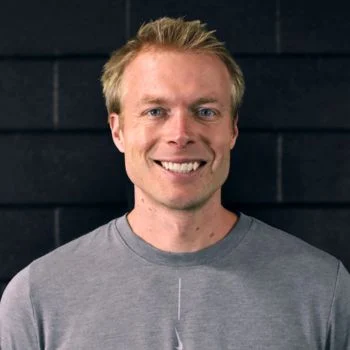
Justin Moore is a strength and conditioning coach at Parabolic Performance and Rehabilitation in New Jersey, where he serves as performance education coordinator and has led the facility’s NFL combine training program. A former college football player, he is known for integrating Postural Restoration Institute (PRI) principles into performance training and for his coaching writing.
Joel Smith is the host of the Just Fly Performance Podcast and the founder of Just Fly Sports, a former collegiate strength and track and field coach focused on speed, power, and athletic development. Listen to the full episode with Justin Moore on Just Fly Sports.


