
Basketball Strength and Conditioning With Jay DeMayo

In this Article
- Key Takeaways
- Basketball strength and conditioning starts with the minimum effective dose
- The 1x20 is really a model of general physical preparedness
- Slow cooking strength: let the athlete set the pace
- Reading the basketball athlete: vertical jump, squat strength, and KPIs
- Autonomy: let the athlete drive the boat
- Dryland for swimmers: train the push and manage fatigue
- Frequently asked questions
- About the authors

Summary
University of Richmond coach Jay DeMayo on basketball strength and conditioning, from the 1×20 model to slow cooking strength and athlete autonomy.
Based on Episode 32 of the Just Fly Performance Podcast, a conversation between host Joel Smith and Jay DeMayo of the University of Richmond.
Good basketball strength and conditioning, the way Jay DeMayo runs it at the University of Richmond, looks less like piling weight on a bar and more like patience. DeMayo is the head strength coach for Richmond basketball, he also trains the women’s swim team, and he organizes the Central Virginia Sport Performance Seminar, where coaches gather to argue and ask questions. His core idea is borrowed and blunt: do what is necessary, not as much as you can. Find the smallest dose of training that produces an adaptation, let the athlete handle it, then add a little. Build strength slowly, give the athlete a say in it, and stop adding load the moment more load stops paying off.
Key Takeaways
- Train the minimum effective dose. DeMayo’s whole model rests on finding the smallest stimulus that produces an adaptation, then nudging it up only once the athlete owns it. Do what is necessary, not as much as you can.
- The 1×20 is a GPP model, not a magic set. The single set of 20 reps is just a vehicle for general physical preparation: connective tissue, strength endurance, and clean motor patterns that specific work later sits on top of.
- Slow cook strength and let athletes set the pace. Progress runs from bodyweight holds to a split stance to loaded variations to a barbell, and each athlete advances only when the rep is clean. A freshman does not have to finish the progression by the first game.
- Read vertical jump against squat strength. When jump height stops rising as the squat climbs, stop chasing load. Strong enough is strong enough, especially for a 6-foot-10 spine.
- Give athletes autonomy, and train swimmers on the push. Let athletes own small exercise choices, and for swimmers emphasize concentric work and fatigue management over heavy eccentrics.
Basketball strength and conditioning starts with the minimum effective dose
DeMayo did not always train this way. He came to it after running a modified version of Jim Wendler’s 5/3/1, getting good strength numbers, and then deciding the order of operations was backward for the athletes in front of him.
I think I made a sandwich with ham on the outside and bread in the middle. And now that we kinda flipped it, I think it kinda helps us a little better.
The principle that replaced it is the one he repeats most. He borrows the phrasing from coach Henk Kruijshof and treats it as the first rule of programming.
Like Henk Kruijshof says all the time, do what’s necessary, don’t do as much as you can. So let’s find the minimum stimulus required to elicit an adaptation. Once they’re able to handle that stimulus, or that adaptation has occurred, increase it slightly.
For a coach, the practical move is to stop opening every block at the athlete’s ceiling. DeMayo starts most athletes well under what they could tolerate, runs roughly the same lift three days a week, and adds small increments only after the current load is clean. The cost of that patience is that progress looks unimpressive early. The payoff is that the athlete keeps progressing for years instead of stalling out in a season.
The 1×20 is really a model of general physical preparedness
DeMayo is one of the coaches associated with the 1×20 strength system, and he spends much of the episode pushing back on how it gets understood. The single set of 20 reps is not the point. The point is the GPP logic underneath it.
People get so enthralled in this whole one by 20 thing, they don’t understand that it’s just a model of GPP. It’s curls. It’s triceps. It’s shoulder raises. It’s pulldowns. We’re just developing connective tissue strength, strength endurance, the capillary density. And we’re just teaching them how to do it better.
The accessory lifts, in his framing, are not where performance is won. They build tissue and teach motor skills so the specific, specialized work can do its job. He pairs the general base with targeted means: active cutting and sprint mechanics drills he traces to biomechanist Anatoliy Bondarchuk’s world, plus a jump progression he attributes to Yuri Verkhoshansky. The general work earns the right to the specific work, not the other way around.
The takeaway for a coach is to stop fighting about exercise minutiae on the GPP side. Whether an athlete does triceps extensions or pushdowns does not decide a season. Pick movements that build tissue and pattern, keep them progressing, and save the obsession for the specific qualities that actually transfer.
Slow cooking strength: let the athlete set the pace
DeMayo’s progressions are written so the athlete, not the calendar, decides when to advance. A split stance pattern, for example, starts with bodyweight holds, moves to 20 clean reps per side, then to holding load, then to a barbell, then to front and rear foot elevated stances. The athlete moves up only when the current step is correct.
One of the benefits of the one by 20 is when you do something well and you can handle the load, you add the load or you change the exercise.
That design quietly removes the fight between the athletes who are ahead and the ones who are behind, because each is dictating their own pace. It also takes the pressure off arriving at a finished product on a deadline.
The goal is not for my 18-year-old freshman basketball player who comes in in June to be able to do that by the first game in November. It’d be great. But who cares? Because at the end of the day, you’re still progressing and moving forward.
He treats every athlete as an individual case even inside a team setting, which is what keeps the slow approach honest.
It’s an N of one. It might be a group of 20, but you gotta handle each kid like it’s 20 groups of one.
For coaches running large groups, the lesson is that a progression is a ladder, not a schedule. Give athletes a clear standard to hit at each rung, let them climb at their own rate, and accept that the ideal end state may arrive next year rather than this one.
Reading the basketball athlete: vertical jump, squat strength, and KPIs
On the court side, DeMayo watches the relationship between vertical jump and squat strength to decide when more weight has stopped earning its keep, which matters when his best squatters are also his tallest players.
Obviously, we look at vertical jump quite a bit. And we look at that versus squat strength, and as they keep adding weight, does that number keep going up? And when that number starts to flatten out, now we need to start thinking about something else, because strong enough is strong enough.
He is also skeptical of chasing vertical jump as an end in itself, and makes the point with a coach’s bluntness about what the sport actually rewards.
We worry so much about vertical with basketball, but the only thing that doesn’t change is the size of the court and the height of the goal.
He is honest that the number still matters for a reason that has nothing to do with biomechanics.
When their vertical jump goes up, they buy in more, and good, bad, or indifferent, that’s just the way it is.
The application: treat jump and squat as a paired indicator rather than two separate maxes to grow forever. When jump flattens while the squat keeps climbing, the extra load is spinal cost without athletic return, and the program should move on to other qualities.
Autonomy: let the athlete drive the boat
The idea DeMayo names as his most unique belief is autonomy, giving athletes real input into their own training rather than handing them a sheet to obey.
I think the autonomy is probably the big one in allowing them to drive the boat a bit.
In practice, that means not litigating every small choice with a college athlete. He prescribes the category and lets the athlete pick the variation, especially on accessory work where the exact tool barely matters.
If they think that doing tricep kickbacks is the greatest thing that’s gonna happen to them, I don’t care what anybody tells me about it. Johnny, knock yourself out. You gotta give them that autonomy, especially this generation. If you can explain it to them and allow them to have input in it, it’s awesome.
For a coach, autonomy is not the absence of structure. DeMayo still sets the standards, the progressions, and the priorities. He simply hands over the low-stakes decisions, which buys buy-in on the high-stakes ones.
Dryland for swimmers: train the push and manage fatigue
DeMayo also trains swimmers, and that work shaped how he thinks about everything else. With his swim group he questioned how much eccentric loading actually helps an athlete whose sport happens with no gravity to fall into, then changed the program around the answer.
When they came back, we took the eccentric stuff out. For the most part, we do a set of squats still, but front squats off the pins, pulling off the floor, things like that where it’s just the push. It’s keep your posture upright, push with your feet.
The reasoning is partly mechanical and partly about recovery. Less eccentric loading means less soreness, which means better practices in a sport already defined by exhaustion.
Because their sport is fatigue. Period. When you wake up at 4:00 in the morning to jump in a box of water to swim 7000 yards, you’re gonna be tired, and it’s about controlling fatigue.
DeMayo is careful to call this a working hypothesis rather than settled science, and credits the swim coaches he works with for cleaning up his mistakes in the water. The transferable point is to match the lift to the sport’s real demands: for swimmers, concentric strength applied off the wall and managed fatigue beat heavy eccentrics and the soreness they bring.
Frequently asked questions
What is GPP in strength training?
GPP stands for general physical preparation, the broad base of strength, connective tissue resilience, strength endurance, and movement quality that specific training is built on. DeMayo treats his 1×20 work as a GPP model: the accessory lifts develop tissue and teach motor patterns, while specialized drills handle the qualities that transfer to sport.
What is the 1×20 strength training program?
It is a system built around a single set of about 20 reps per exercise, used as a vehicle for general physical preparation rather than a maximal-strength method. DeMayo stresses that the rep scheme is secondary; the real engine is building in small increments, keeping technique clean, and adding load or changing the exercise only once the athlete handles the current dose.
Is vertical jump important for basketball?
DeMayo tracks it but warns against chasing it for its own sake, since the rim does not move and a bigger jump past a certain point adds little on the court. He finds its biggest value is paired against squat strength as an indicator, and as a motivator, because athletes buy in when their jump improves.
How is strength training for swimmers different?
DeMayo emphasizes concentric, push-dominant work like front squats off the pins and pulls from the floor, and he minimizes heavy eccentric loading. The goal is to apply force off the wall without piling on soreness, because swimming already runs the athlete into deep fatigue.
What is the minimum effective dose in training?
It is the smallest training stimulus that still produces an adaptation. DeMayo, echoing coach Henk Kruijshof, prescribes the least work required to get a response, lets the athlete absorb it, then increases the load slightly, which keeps athletes progressing for years instead of burning them out early.
About the authors
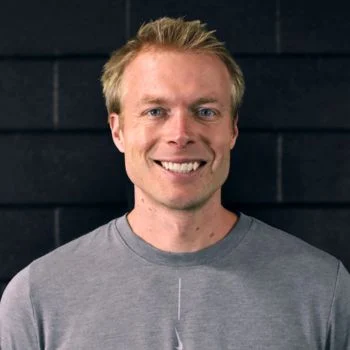
Jay DeMayo is the Head Strength and Conditioning Coach for basketball at the University of Richmond, where he also trains the women’s swim and dive, field hockey, and men’s tennis teams. He spent more than a decade with Nova Aquatics and organizes the Central Virginia Sport Performance Seminar (CVASP), a continuing-education event for coaches and sport scientists.
Joel Smith is the host of the Just Fly Performance Podcast and the founder of Just Fly Sports, a former collegiate strength and track and field coach who focuses on speed, power, and athletic development. Listen to the full episode with Jay DeMayo on Just Fly Sports.

