
Physiological Readiness vs. Recovery: Part 1
In this Article
- Section 1. Introduction: Why the Distinction Between Readiness and Recovery Matters
- Section 2. Defining Recovery: What Systems, Timelines, and Adaptations Are Present?
- Stress as the Driver of Recovery
- Musculoskeletal Recovery: More Than Muscle Soreness
- Metabolic Recovery: Rapid but Not Infinite
- Neurological Recovery: The Often-Ignored Limiter
- Psychological Recovery: The Foundation Beneath Physiology
- Recovery Is System-Specific and Context-Dependent
- Recovery Serves as the Basis for Adaptation
- What's Next?
- Works Cited

Summary
Recovery describes what has happened in response to past stress. Readiness describes what an athlete can tolerate right now. Treating them as the same thing leads to costly mistakes in training and injury management.
Section 1. Introduction: Why the Distinction Between Readiness and Recovery Matters
In contemporary sport and human performance environments, few concepts come up as frequently, and with as little precision, as recovery and physiological readiness. Coaches reference athletes being “recovered.” Sports scientists discuss “readiness scores.” Wearable technologies promise daily insight into whether an athlete is “ready to train.” Despite their widespread use, practitioners often treat these terms as interchangeable, as if they describe the same underlying state.
They do not.
This conceptual confusion is not a minor semantic issue. It directly influences how practitioners prescribe training loads, how they manage fatigue, how injuries occur, and how adaptations unfold over time. When practitioners conflate readiness and recovery, they end up answering the wrong questions. They therefore make the wrong decision, despite having access to more data than ever in the history of strength and conditioning, performance training, sports medicine, and related fields.
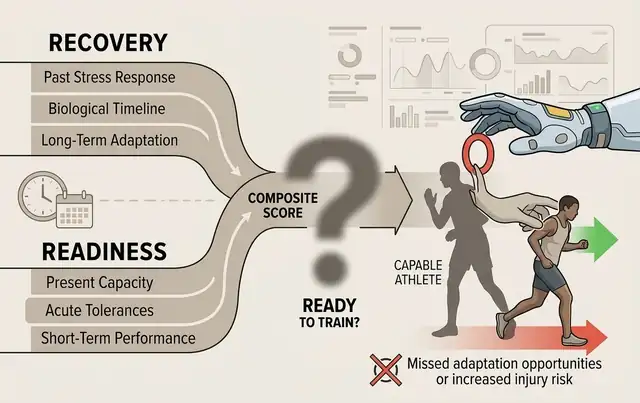
At a surface level, the logic seems sound. If an athlete is recovered, they should be ready. If they are not ready, then they must not be recovered. This assumption is intuitive, simple, and wrong often enough to cause problems in real-world practice. The reality is that recovery and physiological readiness are related, but each is a distinct construct. They operate on different timescales, respond to different stressors, and inform different types of decisions. Recovery describes what has happened in response to past stress.1,2 Readiness describes what the athlete can tolerate in the present moment. When practitioners collapse these concepts into one, coaches lose the ability to distinguish between long-term adaptation needs and short-term performance capacity. The growth of athlete monitoring technology has amplified this issue rather than resolving it. Daily readiness scores, recovery indices, strain metrics, and color-coded dashboards provide the illusion of clarity. Numbers appear objective and actionable, especially when compared to traditional subjective impressions or coaching intuition. Most monitoring systems, however, aggregate multiple signals into a single composite score without clearly defining what that score represents.2,3 Is it nervous system status? Tissue recovery? Psychological freshness? Some combination of all three? When practitioners cannot answer that question, the metric becomes less useful than advertised.
As a result, misinterpretations rather than poor insight frequently drive training decisions. Coaches hold athletes back from productive sessions because a readiness score is low, despite the athlete being fully capable of adapting to the planned stimulus. Coaches push other athletes into high-load sessions because those athletes “feel good” or present favorable readiness metrics, even though underlying tissue recovery is incomplete. In both cases, the cost is the same: missed adaptation opportunities, increased injury risk, or both. This confusion is especially problematic in high-performance settings where the margins for error are small. Non-contact injuries rarely occur because the athlete simply trained “too hard.” More often, they occur because the coach applied the load at the wrong time, under the wrong conditions, or to the wrong system. Understanding whether the limiting factor is recovery or readiness is essential to making that distinction. It is essential to player management for coaches as they plan practice and game plans, for strength and conditioning coaches and performance coaches as they plan their programming, and for sports medicine professionals as they do their best to support athletes while healthy to avoid having them become injured patients.
To complicate matters further, recovery itself is not a single process. Muscular, connective tissue, metabolic, neurological, and psychological systems all recover at different rates and respond differently to various stimuli.4,5 An athlete may be metabolically recovered but neurologically fatigued. The athlete may feel psychologically fresh while connective tissue remains vulnerable. Recovery cannot be reduced to soreness, rest days, or a single biomarker.
Physiological readiness adds another layer of complexity. Readiness is highly sensitive to acute factors such as sleep quality, emotional stress, illness, travel, and life demands outside of sport.6,7 Readiness can fluctuate dramatically from one day to the next, even when training load and recovery status remain unchanged or “balanced.” An athlete who slept poorly or experienced high psychological stress may present with low readiness despite being fully recovered from a mechanical standpoint. Another athlete may feel sharp, motivated, and explosive despite carrying unresolved fatigue.
Both scenarios are common. Both are frequently mismanaged. Not because the coach is “bad” or incompetent, but because these systems are incredibly dynamic and the tools used to measure them have not caught up. A classic example of the science of coaching lagging behind the art of coaching, in a sense.
The core issue is that recovery and readiness answer different questions. Recovery asks, “Has the athlete repaired and adapted from previous stress?” Readiness asks, “What level of stress can this athlete tolerate and express right now?” When coaches fail to distinguish between these questions, they attempt to solve a long-term problem with short-term data. Worse, they make short-term decisions based on long-term assumptions. This article argues that effective coaching requires a clear conceptual separation between recovery and physiological readiness. Not because one is more important than the other, but because each informs a different layer of decision-making. Recovery should guide long-term planning, load progression, and adaptation strategies. Readiness should guide daily execution, session modification, and risk management, particularly injury risk. I wrote this article not to graffiti any individual’s art of coaching, or debunk any science or philosophy of coaching, but rather to shed light on an incredibly complex topic. In its current status, the more we learn about it, the more we learn that we don’t know.
The goal is not to eliminate fatigue or chase perfect readiness. Fatigue is a necessary byproduct of meaningful training. Nor is the goal to outsource decision-making to technology alone. Data, when interpreted correctly, should enhance coaching judgment and performance, not replace it.
Instead, the goal is clarity.
By defining recovery and physiological readiness, understanding why they diverge, and recognizing how each should be applied in practice, coaches can make more intelligent decisions. Decisions that respect biological timelines, account for daily variability, and improve performance while minimizing unnecessary risks. The sections that follow will explore recovery and readiness in detail. These sections will examine the systems involved, the timelines that govern them, and the common mistakes that arise when practitioners misunderstand or misinterpret the data. The intent is practical rather than theoretical. Better questions lead to better answers, better answers result in better decisions, and better decisions lead to better outcomes.
Section 2. Defining Recovery: What Systems, Timelines, and Adaptations Are Present?
Practitioners often discuss recovery as if it were a single, unified process. Something that an athlete either has or does not have. In practice, recovery is far more complex. It’s not a state, a feeling, or a daily score on an application or survey. Recovery is a collection of biological processes that unfold over time in response to stress.5,8 These processes occur across multiple physiological and psychological systems, each operating on its own timeline and each contributing differently to performance and injury risk.
Understanding recovery requires abandoning the idea of a universal recovery clock. There is no single moment at which an athlete is “fully recovered” in all systems simultaneously. Instead, recovery should be viewed as a layered process, where different systems repair, restore, and adapt at different rates depending on the nature of stress applied.
At its most fundamental level, recovery exists to support adaptation. Training stress without recovery does not improve performance; it degrades it. Conversely, recovery without sufficient stress least to stagnation. Effective training lies in the interaction between stress and recovery, not in the elimination of fatigue.
Stress as the Driver of Recovery
We cannot discuss recovery without first defining stress. In applied settings, practitioners often equate stress with training load, but this is an incomplete view. Athletes experience stress from multiple sources, including but not limited to:
- Mechanical stress (eccentric loading, collisions, high speed running, plyometrics, etc.)
- Metabolic stress (poor diet, hydration, and nutrition intake)
- Neurological stress (high-intensity efforts: physical, cognitive, and/or emotional)
- Psychological stress (competition pressure, societal factors, travel, academic demands, etc.)
- Environmental stress (heat, altitude, humidity, time-zone changes, etc.)
The total stress the athlete experiences is the sum of these inputs. Recovery processes respond to the total stress, not just what occurs in the weight room or on the field. I had a great discussion with a coach recently who approached me about his team’s recovery data being as low as it had ever been. He was scaling back practice; their strength and conditioning sessions were scaled back. After investigating further, we learned that one of the players had experienced a tragedy in her family that she had kept from her coaches, and the emotional fallout was radiating through her friend group. There was also an uptick in academic rigor that week. The coach was not wrong or uninformed; he was looking in the wrong direction. This is one of the primary reasons why recovery timelines are difficult to predict and why identical training sessions can produce different recovery responses in different athletes, or even in the same athlete at different times.
Musculoskeletal Recovery: More Than Muscle Soreness
Practitioners often reduce musculoskeletal recovery to the presence or absence of soreness. Soreness, however, is an unreliable proxy for tissue status, and an even worse proxy for the quality of a workout or training session. If that were the case, I would walk around our weight room or practices with a hammer and not a planned program. Muscle damage from muscular contractions triggers an inflammatory response that initiates repair and remodeling. While soreness may resolve within 24-72 hours, the underlying remodeling process may continue beyond the point at which discomfort disappears. Connective tissues such as tendons, ligaments, and fascia all recover and adapt far more slowly than muscle tissue. Tendons, for example, are particularly sensitive to cumulative load rather than single-session stress. Repeated exposure to high strain without sufficient recovery time increases the risk of tendinopathy, even in the absence of acute soreness.
Bone tissue represents an even slower adapting system. Bone remodeling responds to mechanical loading over weeks to months. Bone fatigue, stress reactions, or stress fractures in extreme cases rarely result from a single session; they emerge when recovery is insufficient relative to loading over time. This highlights a critical limitation of daily monitoring tools: many of the most serious recovery-related injuries develop below the resolution of day-to-day metrics.
Metabolic Recovery: Rapid but Not Infinite
Metabolic recovery refers to the restoration of energy substrates, hydration status, and ion balances. Compared to connective tissue recovery, metabolic recovery can occur relatively quickly when nutritional intake is adequate. Athletes can substantially replenish muscle glycogen stores within 24 hours and restore hydration status even more rapidly. The speed of metabolic recovery, however, does not make it immune to accumulation. Repeated glycogen depletion without adequate replenishment leads to chronic fatigue and impaired performance. Similarly, persistent low energy availability compromises recovery across all systems, including hormonal function, immune health, and bone mineral density. Metabolic recovery is also context-dependent. High-volume endurance training, repeated sprint work, and competition schedules that limit fueling opportunities all increase the likelihood that metabolic recovery becomes a limiting factor, even when mechanical stress is modest.
Neurological Recovery: The Often-Ignored Limiter
Neurological recovery refers to the restoration of central nervous system function following high neural demand. This includes motor unit recruitment, coordination, reaction time, and decision-making. Neurological fatigue is less visible than muscular fatigue but can have a profound impact on performance quality and especially injury risk.9 High-intensity sprinting, maximal strength training, complex skill acquisition, and competitive play all place significant demands on the nervous system. Unlike muscle tissue, the nervous system does not display clear markers of damage or repair. Instead, neurological fatigue often manifests as reduced explosiveness, impaired coordination, slower reactions, and diminished focus.
Sleep plays a disproportionate role in neurological recovery. Inadequate sleep impairs central nervous system restoration even when other recovery strategies are optimized. Psychological stress further compounds this effect, creating a scenario in which athletes may appear physically recovered but neurologically compromised.
Psychological Recovery: The Foundation Beneath Physiology
Practitioners frequently treat psychological recovery as separate from physical recovery, yet the two are inseparable.5,7 Emotional stress, cognitive fatigue, and motivational depletion directly influence physiological recovery processes through hormonal and autonomic pathways.
Competition anxiety, academic pressures, family stress, and travel fatigue all increase sympathetic nervous system activity. Prolonged sympathetic dominance interferes with sleep quality, appetite regulation, and immune function. Over time, this delays recovery across multiple systems.
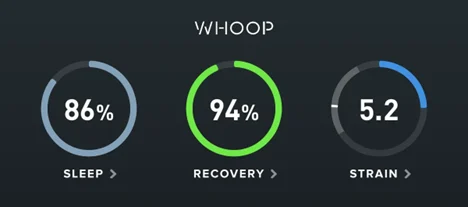
1. This is an example of a dashboard reading for WHOOP©. While it gives Sleep, Recovery, and Strain, it does not initially give factors that play into each of these three metrics. It takes time for these to normalize, usually 1-2 weeks, and much detail into journaling in this program’s case to dig deeper into what affects each metric. Without knowing these mediating and moderating factors, coaches have difficulty making adaptations. Otherwise, they are done by guessing and not objectively measured.
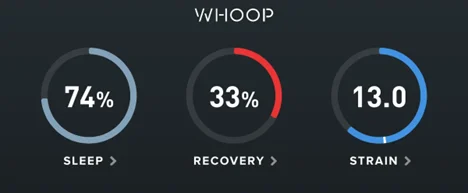
2. Here is an example of when sleep was decent but recovery is low. In this case specifically, the individual was moderately to strongly ready from a physiological readiness standpoint but was very poorly recovered. For cases like this, we have the athlete complete the normal workout but decrease volume. Specifically, we have the athlete do all the normal exercises but cut the sets in half.
Psychological recovery does not require the absence of stress. It requires sufficient capacity to cope with stress. Athletes with strong support systems, autonomy, and perceived control often recover more efficiently from identical training loads than those who experience chronic psychological strain.
Recovery Is System-Specific and Context-Dependent
One of the most common mistakes in applied settings is assuming recovery can be summarized with a single label. An athlete is not simply “recovered” or “not recovered.” Recovery is a spectrum that combines the status of many systems, not a dichotomized yes or no. An athlete may be recovered in one system and compromised in another. This system-specific nature of recovery explains why certain training sessions feel productive while others feel flat, even when performed under similar conditions. This system-specific nature also explains why some injuries occur despite favorable monitoring or performance data.
Effective recovery management requires identifying which system is limiting adaptation or increasing risk. A single metric or score cannot accomplish this. It requires context, longitudinal observation, and an understanding of the training demands the coach imposes.
Recovery Serves as the Basis for Adaptation
Recovery is not the absence of training. It is a biological response that allows training to work. When recovery is insufficient, training stress accumulates without producing adaptation. When recovery is excessive relative to stress, adaptation stalls. When recovery is sufficient and the coach applies optimal training stimuli, adaptation occurs, resulting in a higher workload capacity or performance metric(s). The coach’s role is not to eliminate fatigue but to manage it intelligently. This requires respecting biological timelines, recognizing system-specific recovery demands, and avoiding the temptation to treat recovery as a binary outcome.10
In the next section, we will examine physiological readiness in detail: how it differs from recovery, why it fluctuates so rapidly, and why practitioners often misinterpret it as a recovery metric. Understanding this distinction is essential for applying recovery principles efficiently in real-world practice.
What’s Next?
The next part in this series will define recovery and readiness in the “real life” setting. It will also go into depth on why a given status in one of those metrics does not equate to a similar status in the other.
Works Cited
- Bishop, Phillip A., et al. “Recovery from Training: A Brief Review.” Journal of Strength and Conditioning Research, vol. 22, no. 3, 2008, pp. 1015–1024.
- Halson, Shona L. “Monitoring Training Load to Understand Fatigue in Athletes.” Sports Medicine, vol. 44, suppl. 2, 2014, pp. S139–S147.
- Impellizzeri, Franco M., et al. “Internal and External Training Load: 15 Years On.” International Journal of Sports Physiology and Performance, vol. 14, no. 2, 2019, pp. 270–273.
- Magnusson, S. Peter, and Michael Kjaer. “Tendon Properties in Relation to Muscular Activity and Physical Training.” Scandinavian Journal of Medicine & Science in Sports, vol. 29, no. 7, 2019, pp. 115–123.
- Meeusen, Romain, et al. “Prevention, Diagnosis, and Treatment of the Overtraining Syndrome.” European Journal of Sport Science, vol. 13, no. 1, 2013, pp. 1–24.
- Fullagar, Hugh H. K., et al. “Sleep and Athletic Performance: The Effects of Sleep Loss on Exercise Performance.” Sports Medicine, vol. 45, no. 2, 2015, pp. 161–186.
- McEwen, Bruce S. “Physiology and Neurobiology of Stress and Adaptation: Central Role of the Brain.” Physiological Reviews, vol. 87, no. 3, 2007, pp. 873–904.
- Kellmann, Michael. “Preventing Overtraining in Athletes in High-Intensity Sports and Stress/Recovery Monitoring.” Scandinavian Journal of Medicine & Science in Sports, vol. 20, suppl. 2, 2010, pp. 95–102.
- Enoka, Roger M., and Jacques Duchateau. “Translating Fatigue to Human Performance.” Medicine & Science in Sports & Exercise, vol. 48, no. 11, 2016, pp. 2228–2238.
- Gabbett, Tim J. “The Training–Injury Prevention Paradox: Should Athletes Be Training Smarter and Harder?” British Journal of Sports Medicine, vol. 50, no. 5, 2016, pp. 273–280.

