

Physiological Readiness vs. Recovery: Part 2
In this Article
- Section 3: Defining Physiological Readiness. What Are Its Acute Capacity, Variability, and Controls?
- Readiness as an Integrated System Output
- Why Does Readiness Fluctuate So Rapidly?
- Readiness Is Not Recovery in Disguise
- The Role of Perception in Readiness
- Readiness and Performance Quality
- Control Versus Prediction
- Readiness as a Coaching Tool, Not a Verdict
- Section 4: Why Readiness Does Not Equal Recovery. Applied Scenarios, Risk, and Misinterpretation
- Scenario 1: Recovered but Not Ready
- Scenario 2: Ready but Not Recovered
- Scenario 3: Low Readiness and Low Recovery
- Scenario 4: High Readiness and High Recovery
- Misinterpretation of Monitoring Data
- Readiness as a Risk Modifier, Not a Green Light
- The Cost of Conflating Readiness and Recovery
- Applying the Distinction in Practice
- What's Next?

Summary
Physiological readiness and recovery are not the same thing. Understanding how and why they diverge helps coaches make smarter daily training decisions, reduce injury risk, and maximize adaptation.
Section 3: Defining Physiological Readiness. What Are Its Acute Capacity, Variability, and Controls?
If recovery describes what has happened in response to past stress, physiological readiness describes what is possible for the present moment. While recovery unfolds over time and supports adaptation, readiness reflects the athlete’s current capacity to tolerate and express stress(ors). This distinction is subtle in theory but profound in practice, and even more profound in science. Physiological readiness is not a measure of repair. Readiness does not tell the coach how much tissue remains, how complete connective tissue remodeling is, or whether long-term recovery processes have concluded. Instead, readiness captures the integrated output of multiple systems as they present right now. Readiness answers a different question entirely: “What can this athlete handle today during this session?” Understanding readiness requires shifting away from the idea of recovery as a prerequisite for performance. Athletes routinely perform, and sometimes perform exceptionally well, without being fully recovered. Competition environments, psychological arousal, and adrenaline can all temporarily elevate readiness even when fatigue is present. Conversely, athletes can be fully recovered from a structural standpoint yet present with low readiness due to poor sleep, stress, or illness.
Readiness as an Integrated System Output
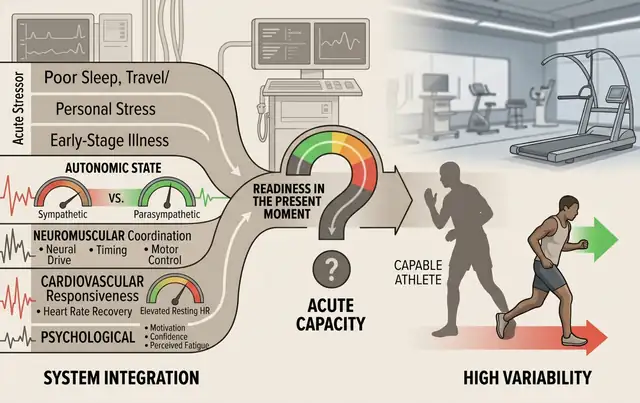
Physiological readiness emerges from the interaction of several systems rather than the status of any single one. These systems do not operate independently; they influence and constrain one another in real time. The most influential contributors to readiness include the autonomic nervous system, neuromuscular coordination, cardiovascular responsiveness, and psychological state.
The autonomic nervous system (ANS) plays a central role in readiness because it governs the balance between sympathetic and parasympathetic activity. A state of excessive sympathetic dominance, often associated with stress, poor sleep, or illness, reduces readiness even when other systems appear intact. Conversely, a well-regulated ANS state supports coordination, decision-making, and efficient force production. Neuromuscular readiness reflects the athlete’s ability to coordinate movements, recruit motor units efficiently, and express force quickly. This is why athletes often describe feeling “sharp,” “flat,” or “heavy” on certain days. Athletes often frame these descriptions by comparing their current status relative to the status of other days. These sensations are not imaginary; they reflect real changes in neural drive, timing, and motor control. Cardiovascular readiness influences how efficiently the athlete responds to submaximal and maximal demands. Elevated resting heart rate, exaggerated heart rate responses, or poor heart rate recovery can indicate reduced readiness, even when metabolic recovery appears complete.
Psychological readiness ties all these systems together. Motivation, confidence, emotional state, and perceived fatigue influence movement quality, injury risk tolerance, and effort regulation. Psychological readiness does not merely reflect physiology. It actively shapes it through autonomic and hormonal pathways.
Why Does Readiness Fluctuate So Rapidly?
One of the defining characteristics of physiological readiness is variability. Unlike recovery, which changes gradually, readiness can fluctuate dramatically from day to day or even within the same day. This variability is not a flaw in the concept; it is a defining feature.
Readiness is highly sensitive to acute stressors. Sleep quality is one of the most powerful drivers. A single night of poor sleep can significantly suppress readiness by altering autonomic balance, cognitive function, and emotional regulation. Psychological stress from competition pressure, work demands, or personal life can have a similar effect. Travel, particularly across time zones, disrupts circadian rhythms and autonomic regulation, often reducing readiness even when the training load is low. Early-stage illness can suppress readiness before overt symptoms appear. Environmental stressors such as heat and altitude can further complicate the situation.
Because readiness reflects system integration rather than tissue repair, these acute stressors exert disproportionate influence. An athlete may be mechanically recovered but neurologically and psychologically unprepared to express high-quality performance.
Readiness Is Not Recovery in Disguise
A common error in applied settings is treating readiness metrics as indirect measures of recovery. Heart rate variability (HRV), resting heart rate, sleep scores, and subjective questionnaires are often interpreted as evidence that recovery has or has not occurred. This interpretation misunderstands what these metrics actually reflect. Most readiness indicators are dominated by autonomic and psychological inputs. They tell the coach how the athlete’s nervous system is responding to stress right now, not whether the muscle fibers have repaired or connective tissue has adapted. When readiness metrics improve quickly, this often reflects nervous system regulation rather than structural recovery.
This distinction explains a common observation: readiness metrics often normalize faster than soreness or fatigue resolves. Coaches may interpret this normalization as evidence that recovery is complete and increase load prematurely. In reality, readiness has improved while recovery remains ongoing. Readiness is best viewed as a filter through which coaches apply training stress. Readiness does not determine whether stress is needed; readiness determines how stress should be applied during a specific session, practice, training, meeting, film session, etc.
The Role of Perception in Readiness
Athlete perception plays a critical role in readiness. Perceived fatigue, motivation, and confidence influence how effort is distributed and how movements are executed. These perceptions are not merely psychological; they reflect real physiological states.
An athlete who perceives high fatigue often subconsciously alters movement strategies, reduces force output, or hesitates under load. An athlete who feels confident and energized is more likely to participate aggressively and tolerate higher intensities. These behavioral changes influence both performance outcomes and injury risk. This is why subjective readiness measures, when collected honestly and consistently, are valuable. Athletes integrate signals across all systems in a way that objective measures cannot currently capture in full. While subjective data is imperfect, dismissing it removes a critical layer of insight. Coaches also need to be cognizant of athletes who tell us what they think we want to hear. This is where emotional intelligence and building relationships are critical in successful coaching.
Readiness and Performance Quality
One of the most practical reasons to monitor readiness is its relationship to performance quality. High readiness does not guarantee superior performance, but low readiness often predicts reduced quality of execution. This is particularly true for tasks that require precision, speed, and coordination on the individual level.
Sprint mechanics, technical skill execution, and high-velocity movements are especially sensitive to readiness fluctuations. Attempting to perform these tasks under low readiness conditions may not increase injury risk immediately, but doing so often reduces the session’s effectiveness and predisposes the individual to injury when chronically exposed. Poor-quality repetitions accumulate without delivering the intended stimulus. The result is poorer acute performance than if readiness were higher and the creation of bad habits or poor mechanics over time.
This has especially important implications for session design. Not every session requires maximal readiness. Aerobic work, general strength training, and low-skill conditioning may be productive even when readiness is modest. High-speed, high-skill, or high-risk tasks demand greater readiness to justify their cost.
Control Versus Prediction
Another misunderstanding is the belief that readiness monitoring should predict future outcomes. In reality, readiness is best used as a control mechanism rather than a predictive one. Readiness helps coaches adjust inputs in real time rather than forecast distant events.
Attempting to predict injury or performance weeks in advance using daily readiness metrics is unrealistic. Readiness data excels at answering immediate questions: Should intensity be adjusted today? Should volume be reduced? Should the focus shift from execution to skill acquisition?
When used this way, readiness monitoring supports intelligent decision-making without overreaching its capabilities.
Readiness as a Coaching Tool, Not a Verdict
Physiological readiness should inform conversations, not dictate outcomes. A low readiness day does not automatically require rest, just as a high readiness day does not mandate maximal training. Context matters. Training rules matter. Athlete history matters. The coach’s task is to interpret readiness within the broader framework of recovery, periodization, and long-term development. Readiness is not one singular input among many but a uniquely valuable one because it reflects how the athlete is prepared to engage with stress right now.
In the next section, we will examine why readiness and recovery so often diverge in practice and how misunderstanding this divergence leads to poor training decisions, unnecessary risk, and missed adaptation opportunities.
Section 4: Why Readiness Does Not Equal Recovery. Applied Scenarios, Risk, and Misinterpretation
The most important practical implication of distinguishing recovery from physiological readiness is understanding how and why the two frequently diverge in real training environments. While it is tempting to assume that recovery and readiness move together, experience and science show us that this alignment is the exception rather than the rule. When coaches fail to recognize this divergence, they often apply the right stimulus at the wrong time or the wrong stimulus with the right intent. Recovery and readiness diverge because they respond differently to different stressors, operate on different time scales, and reflect different biological priorities. Recovery is governed by structural and metabolic processes that require time. Nervous system regulation and psychological state, which can change rapidly, largely govern readiness. These differences create predictable scenarios that, when misunderstood, increase risk and reduce training effectiveness, ultimately decreasing performance.
Scenario 1: Recovered but Not Ready
One of the most common divergence patterns is the athlete who has recovered from a tissue and metabolic standpoint but presents with low readiness. This scenario often emerges after periods of disrupted sleep, high psychological stress, or travel, especially across time zones. The athlete may report minimal soreness, stable body mass, and no residual fatigue from previous sessions, yet objective and subjective readiness indicators suggest compromised capacity.
In this state, the limiting factor is not structural integrity but systems integration. Autonomic imbalance reduces attentional capacity, and impaired coordination reduces the athlete’s ability to express force efficiently and consistently. Movement quality often suffers, reaction time slows, and decision-making becomes less precise. Training in this state is not inherently dangerous, but it is often unproductive when the session demands high precision, speed, or technical execution. Sprint mechanics, complex skill work, and maximal power output are particularly sensitive to reduced readiness. Coaches who ignore the signal and proceed as planned often report “flat sessions” where outputs are present but quality is lacking.
The error here is assuming that recovery guarantees readiness. Recovery does not guarantee readiness. Recovery allows adaptation to occur; readiness determines how well the athlete can access that capacity today.
Scenario 2: Ready but Not Recovered
The inverse scenario, high readiness in the presence of incomplete recovery, is more dangerous and more frequently associated with injury. Athletes in this state report feeling sharp, motivated, and energized. Readiness metrics may appear favorable. Psychological arousal, competition proximity, or novelty can elevate nervous system output and temporarily mask underlying fatigue. This is the classic scenario where adrenaline hides damage.
While the athlete may be capable of expressing high outputs, the cost of doing so is increased because tissues have not fully adapted to previous loading. Connective tissue structures are particularly vulnerable in this state. Tendons, fascia, and musculotendinous junctions may face loads they are not prepared to tolerate, either acutely or chronically. This scenario explains why many non-contact injuries occur during the session that “felt good” leading up to the incident. Readiness was high, but recovery was incomplete. Coaches who rely solely on readiness metrics to greenlight high-load sessions in these circumstances are often surprised by the commonly negative outcomes.
Scenario 3: Low Readiness and Low Recovery
When both readiness and recovery are compromised, the signal is usually clear. The athlete reports fatigue, poor sleep, persistent soreness, and reduced motivation. Objective measures often align with these reports. In this state, aggressive loading is unlikely to produce meaningful adaptation and carries elevated risk, often for extended periods of time. The mistake here is not recognizing the need for adjustment but rather failing to act on it. Cultural pressures, rigid programming, or fear of losing training or playing time often lead players and coaches to “push through” despite clear warning signs. Over time, this approach erodes resilience and increases injury risk at minimum. At maximum, it erodes the athletes’ interest, performance, or both in the sport they once loved. This state often emerges not from a single mistake or game but from cumulative effects over time leading to a burnout-type situation: ignoring readiness on days when recovery was already compromised or extending high-load phases beyond their useful window.
Scenario 4: High Readiness and High Recovery
This is the ideal alignment and least problematic scenario. The athlete is structurally prepared, metabolically restored, neurologically regulated, and psychologically engaged. High-quality loading in this state supports adaptation and progression. The mistake in this scenario is often underutilization of stimuli or stressors. Coaches may become overly conservative due to fear of regression or injury, missing valuable opportunities to apply stress when the system is most capable of responding positively. Understanding readiness and recovery allows coaches to recognize and capitalize on these windows rather than defaulting to rigid plans or programming.
Misinterpretation of Monitoring Data
Many of the errors described above are reinforced by how monitoring data is interpreted. Composite readiness or recovery scores obscure the underlying drivers of change. A favorable score may be driven by improved sleep or reduced psychological stress, while tissue recovery remains incomplete. A poor score may reflect acute stress unrelated to training load.
When coaches interpret data without context, it becomes prescriptive rather than informative. Coaches react to numbers rather than understanding the systems behind them. This leads to overcorrections such as canceling sessions unnecessarily or prescribing intensities or volumes beyond safe ranges. It can also lead to undercorrections such as failing to adjust intensities, volumes, or types of stressors when the risk is elevated.
Effective use of monitoring data requires asking the right questions. Is this metric reflecting readiness or recovery? What system is driving the change? How does this align with the demands of today’s session?
Readiness as a Risk Modifier, Not a Green Light
One of the most important reframes is viewing readiness as a risk modifier rather than a green light. A high readiness score does not eliminate risk. High readiness modifies how risks are distributed across systems. Low readiness does not prohibit training; it changes which types of stressors are appropriate.
This perspective shifts decision-making from binary choices to graduated adjustments. Coaches can reduce volume without eliminating intensity. They can maintain intensity while reducing complexity. Technical focus can replace maximal output. Coaches who adopt this approach preserve training continuity while respecting daily variability to put their athletes in positions to be successful.
The Cost of Conflating Readiness and Recovery
When readiness and recovery are treated as the same thing, coaches lose resolution. They are forced into all-or-nothing decisions that rarely reflect biological reality. This increases volatility in training load and erodes athlete trust in monitoring systems, whether tech-based or subjective. Athletes quickly recognize when metrics are used inconsistently or without explanation. When a “bad score” leads to reduced training one day and is ignored the next, credibility suffers. Clear conceptual understanding allows coaches to explain decisions in a way that athletes can understand and support.
Applying the Distinction in Practice
The practical value of separating readiness from recovery lies in decision timing. Recovery should guide long-term planning, load progression, and deload strategies. Readiness should guide daily execution, session emphasis, and risk management. When coaches respect these roles, training becomes more flexible without becoming chaotic. Coaches preserve structure but improve responsiveness.
In the final section, we will integrate these concepts into a conceptual framework, examining how readiness and recovery inform monitoring strategies, wearable technology data interpretation, and day-to-day coaching decisions.
What’s Next?
The next and last portion of this series will go extensively into frameworks and modeling of wearables and how coaches can implement wearables into their settings with minimal disruption to their current practices.

