
The Missing Link in High School S&C: Unified Athletic Performance Leadership
In this Article
- Introduction
- The Problem
- My Experience
- Supervision vs. Development
- The Cost of Inconsistency
- What Unified Athletic Performance Leadership Actually Means
- Redefining Supervision
- Aligning PE, Athletics, and Offseason Training
- 1. Movement Literacy
- 2. Building a Foundation of Strength
- 3. Maximizing Strength Development
- 4. Speed and Power Transfer
- Year-Round Access to Structured Training
- Athletic development cannot be seasonal. A Director of Athletic Performance designs comprehensive training calendars that:
- The Director as Sport Scientist: Data-Driven Decision Making
- 1. The Performance Lens vs. the Meathead Lens
- 2. Athlete Wellness and the "Stoplight System"
- Green Light (90–100% Readiness)
- Yellow Light (70–80% Readiness)
- Red Light (<70% Readiness)
- 3. Load Management: Being the "Safety Valve"
- Why This Role Changes Everything
- The Logistics of Alignment
- The Administrative Perspective
- The Missing Link
- References and Recommended Reading

Summary
Most high schools don’t have a training problem. They have a leadership and alignment problem. Here’s how a Director of Athletic Performance creates a unified system that drives real, measurable athlete development.
Introduction
Walk into almost any modern high school weight room, and it looks like progress. Racks line the walls, the room is full after school, and athletes move from station to station with programs written neatly across the whiteboard.
From the outside, it appears that athletic performance is thriving. Yet the same questions persist across schools nationwide:
- Why aren’t our athletes making consistent year-to-year gains?
- Why do injury rates remain high despite better equipment?
- Why does off-season participation fluctuate?
- Why do freshmen arrive underprepared?
- Do seniors graduate without measurable physical benchmarks?
The uncomfortable truth is this: most high schools do not have a training problem. They have a leadership and alignment problem.
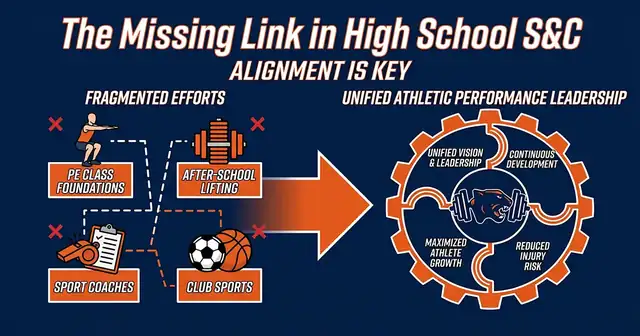
Athletic performance in secondary education is often fragmented across departments, personalities, and seasonal demands. Physical education operates independently. After-school lifting becomes supervised access. Sport coaches manage their own conditioning. Summer programming varies by team. Everyone works hard, yet few work under a unified vision. Without unified leadership, even good training becomes inconsistent, which makes progress stall and performance go stale.

The Problem
In many school systems, athletic development exists in pieces that rarely connect:
- Physical Education teaches foundational movement skills.
- After-school programs provide strength and weight-lifting opportunities.
- Sport coaches run their own conditioning programs.
- Club sports add stress outside of school oversight.
- Summer training is optional and inconsistent.
Each program has good intentions, but no one owns the full developmental pathway from freshman year through graduation.
When departments work in isolation:
- Movement standards are inconsistent.
- Terminology varies between programs.
- Load progressions lack continuity.
- Conditioning volumes can overlap or conflict.
- A freshman’s development depends largely on who happens to supervise.
A student might learn solid squat or hinge mechanics in PE, only to move into an after-school lift where load takes precedence over technique. Then a coach might add conditioning on top of that without syncing it to the bigger picture. No one is doing anything “wrong,” but no one is working in alignment. True, measurable adaptation comes from that alignment: a clear, intentional pathway guiding every step of development.
My Experience
I’ve had the opportunity to experience both ends of the spectrum, and that perspective has shaped how I see this work.
At my previous school, athletics and physical education were fully aligned around one shared approach to strength and speed development. It wasn’t two separate systems trying to coexist. It was one cohesive model. What we taught during the school day carried directly into what happened after school. The language, the progressions, the expectations: all of it matched. Athletes weren’t bouncing between different philosophies or adapting to conflicting messages. They were developing within a system that made sense from start to finish.
That alignment created clarity. It allowed us to be intentional with how we progressed athletes, how we managed volume, and how we built from general development to more sport-specific outputs. It also created a strong sense of ownership. Standards were clear, communication was consistent, and everything had a purpose behind it. With administrative support behind it, the program became sustainable, efficient, and impactful.
In my current role, the structure within physical education is something I’m incredibly proud of. In a school of nearly 3,000 students, our PE department (20 teachers strong) has fully bought into a unified LTAD model. That’s no small thing. We’ve built a consistent approach across all grade levels that is already paying off. You can see it in the way students move, in their strength levels, in their speed and power outputs. There’s intent behind what we’re doing, and there’s real momentum behind it.
We’ve implemented meaningful change in a short amount of time, and the level of buy-in across the department speaks volumes. There’s a shared understanding of what we’re trying to build, and people are working hard to bring it to life every day. That foundation matters, and it’s something a lot of places never establish.
At the same time, the reality of a large system without a single point of coordination presents challenges. Not because people don’t care—but because there isn’t a structure in place to connect everything. As a result, some inefficiencies start to show up. Spaces can get crowded. Equipment doesn’t always get the attention it needs. Athletes can experience overlap in training that isn’t always aligned.
But those challenges don’t take away from the progress—they highlight the opportunity.
Right now, we’re at a tipping point. We’ve done an excellent job building a unified approach within physical education. That side of the system is strong, consistent, and moving in the right direction. The next step is expanding that same level of alignment across the entire athletic experience.
On one side, we have what currently exists: a highly organized and intentional PE program alongside athletic programs that are working hard, but largely operating independently. On the other side is the opportunity to bring it all together—to create a fully unified model where physical education and athletics are working in sync to support long-term athlete development.
That’s where the real growth is.
The pieces are already in place: buy-in, structure, intent, and momentum. What’s missing isn’t effort; it’s alignment at the system level. Bridging that gap isn’t about starting over. It’s about connecting what’s already being done well and elevating it into something even more impactful.
That’s why the need for a dedicated leadership role becomes so clear. Not just to manage workouts, but to provide direction, coordination, and oversight across the entire system.
Because when everything is aligned, good programs become great, and great programs become sustainable.
Supervision vs. Development
Many schools proudly advertise open access to the weight room. But access alone does not equal development. There’s a critical distinction between supervising workouts and running a structured, intentional athletic performance system. Supervision ensures safety and participation, but it does not ensure progress.
In a typical supervision model, someone posts a workout on the board, athletes rotate through exercises, a coach monitors for safety, and staff record attendance.
This approach creates participation, but it rarely drives meaningful improvement. Athletes may complete sessions week after week without measurable gains in strength, speed, or movement quality. They may lift heavier without improving technique or accumulate volume that conflicts with other training or sport demands.
True athletic development requires far more than presence. It demands a system. A comprehensive performance system includes:
- A defined 9–12 progression model: Each year builds on the previous one, guiding freshmen toward senior-level competency in strength, power, and movement.
- Movement competency standards: Every lift, sprint, and jump is measured against clear technical criteria, ensuring safety and long-term capacity.
- Measurable KPIs: The staff tracks performance objectively, so they document progress rather than assume it.
- Coordinated load management: Strength, conditioning, and sport-specific demands are balanced to optimize adaptation while reducing injury risk.
- Shared language across staff: Coaches, PE teachers, and trainers communicate consistently, avoiding confusion or conflicting instructions.
- Year-round continuity: Development does not stop at the end of the season. Training stays intentional and cumulative across the entire school year.
Without these components, a weight room is merely a place to lift. With them, it becomes a system: a deliberate, data-driven environment where every session contributes to long-term athlete growth.
The Cost of Inconsistency
Fragmentation in athletic development produces predictable, and avoidable, outcomes:
- Overuse injuries from unmonitored or overlapping training loads.
- Strength plateaus caused by haphazard or unstructured progression.
- Poor sprint mechanics reinforced year after year.
- Confusion among athletes about expectations and priorities.
- A culture that undervalues off-season work and preparation.
Athletes are acutely aware of these inconsistencies. They notice when different coaches cue squats differently, or when conditioning sessions contradict strength goals. They feel the gap between what’s expected of a freshman versus a varsity athlete, and they experience frustration when development feels random rather than purposeful.
Over time, these inconsistencies do more than frustrate. They erode trust. Trust between athletes and staff is the foundation of culture. And culture, in turn, is what drives consistent development, commitment, and long-term performance gains.
In other words, inconsistency doesn’t just limit results. It undermines the very environment that allows athletes to grow.
What Unified Athletic Performance Leadership Actually Means
The solution to fragmented athletic development isn’t more equipment. It isn’t another summer camp. And it isn’t simply hiring someone to “run the weight room.” The solution is structural. It requires intentional leadership that connects every aspect of an athlete’s development into a coherent system.
Establish a Director of Athletic Performance at Every High School: This role goes far beyond a traditional strength coach. A Director of Athletic Performance is a systems architect, responsible for designing, coordinating, and overseeing the entire performance ecosystem. They should be responsible for:
- Leading/coordinating all strength, speed, and conditioning programs across PE, before/after-school training, and athletics.
- Designing year-round training calendars that integrate with sport schedules, preventing overload and optimizing adaptation.
- Ensuring a long-term athletic development (LTAD) model that progresses students safely and effectively from grades 9 through 12.
- Supervising, mentoring, and assisting all teachers and coaches leading strength, speed, or conditioning sessions in order to build consistency in instruction and coaching philosophy.
- Tracking performance metrics and athlete development data, turning observation into actionable insight.
- Serving as the central point of communication among coaches, PE staff, and administrators, ensuring everyone is aligned.
This position establishes ownership. And ownership drives alignment—the single most important factor in turning fragmented efforts into real, measurable athlete development.
Redefining Supervision
Many schools compensate staff with stipends simply to supervise the weight room. Supervision alone does not create development. By redefining these roles, expectations shift. Coaches are no longer there just to monitor; they are active leaders in the athlete development process.
Coaches are expected to:
- Reinforce established movement standards consistently.
- Deliver structured, evidence-based programming aligned with overall development goals.
- Maintain consistent cueing and technique correction across sessions.
- Uphold clear progression criteria for each athlete, ensuring growth and safety.
This shift transforms the environment. What was once access-based—where presence was enough—becomes development-driven, where every session, every cue, and every progression contributes to long-term athlete growth.
Aligning PE, Athletics, and Offseason Training
Long-Term Athletic Development (LTAD) should not remain a theoretical concept. It should guide every aspect of athletic programming. A truly unified system ensures each year builds intentionally on the last, with clearly defined goals, standards, and measurable outcomes. Progression should occur across four key areas:
1. Movement Literacy
- Emphasizes foundational movement skills: bodyweight competency, sprint posture, landing mechanics, and positional awareness. This phase establishes safe, efficient, and adaptable athletes.
- Importantly, movement literacy begins in middle school, creating a foundation that ensures high school athletes arrive ready to progress efficiently.
2. Building a Foundation of Strength
- Introduces progressive overload while emphasizing technical mastery.
- Tracks relative strength benchmarks and implements measurable KPIs, ensuring that growth is intentional, objective, and sustainable.
3. Maximizing Strength Development
- Focuses on advanced strength expression while refining speed mechanics.
- Data-driven load adjustments inform training to optimize power transfer and reduce injury risk.
4. Speed and Power Transfer
- Delivers individualized programming aligned with each athlete’s goals, in-season demands, and exit benchmarks that demonstrate measurable growth.
Each phase builds on the last. No repetition, no randomness. Just intentional, cumulative progression designed for long-term athletic growth.
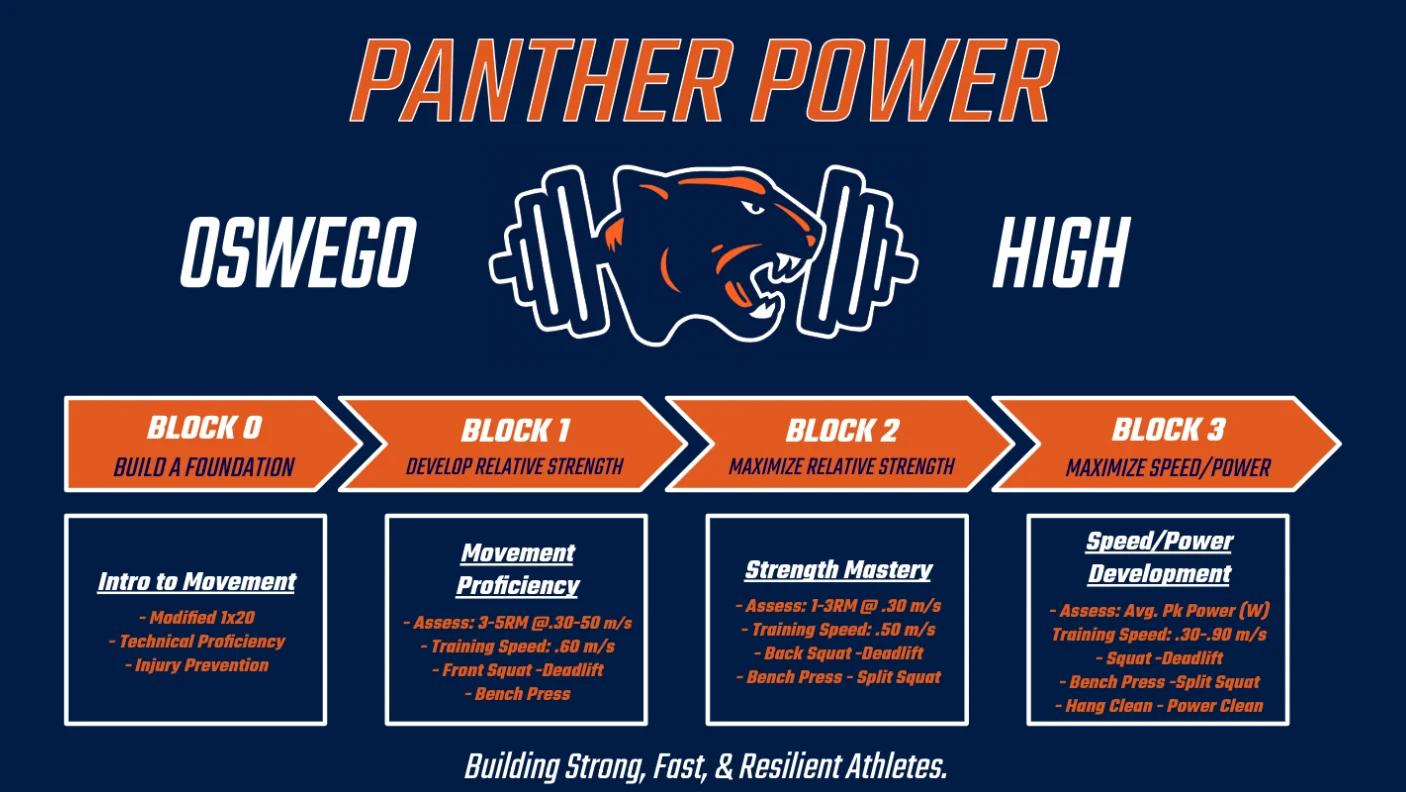
Our current blueprint is built on priming performance through neurological prep, movement quality, increasing relative strength, and developing both speed and power. Every session starts with RPR to ensure we get our nervous system and muscular system firing together. We always strive to get athletes out of survival mode and into a performance state before we train. We always do our most explosive work first and then move into strength. The goal is simple: teach athletes to express force at high speed, then build the strength to support it.
Because we’re dealing with a wide range of athletes—from 13-year-old beginners to 18-year-old advanced lifters—we have to be flexible with our approach. We don’t marry one system; we use the right tool for the job, depending on the athlete in front of us.
Our base layer is the 1×20 Method, especially for freshmen; every kid will go through this when they come to us. It’s all about building the engine: developing work capacity, reinforcing movement patterns, and strengthening connective tissue without overwhelming them with fatigue. The 1×20 Method keeps athletes progressing without breaking them down early.
We then layer in APRE to autoregulate strength work. We’ll use higher rep ranges (10s and 8s) to build volume and resilience, then progress into 6s and 4s as we chase strength. The key is that the load adjusts based on performance that day. If an athlete is fatigued from school, stress, or lack of sleep, the system accounts for it. We’re coaching the athlete in front of us—not just chasing a number on paper.
For our more advanced athletes, we lean heavily on VBT (Velocity Based Training) to keep intent high. We’re looking at bar speed in real time to make adjustments on load. If the bar slows down, the load comes off. If it moves well, we can push it. VBT removes the guesswork and gives us immediate feedback on whether the training stimulus is actually doing what we want it to do.
When you combine all of that (CNS priming, 1×20 movement preparation, APRE autoregulation, VBT feedback, and a clear progression model) you get a system that adapts to the athlete, not the other way around.
Year-Round Access to Structured Training
Athletic development cannot be seasonal. A Director of Athletic Performance designs comprehensive training calendars that:
- Align offseason blocks with sport-specific demands.
- Coordinate preseason preparation.
- Protect in-season recovery.
- Manage transition phases between sports and school schedules.
This coordinated approach prevents overlapping conditioning loads, reduces unnecessary fatigue, and ensures equitable access to structured, high-quality development for every student-athlete—not just select teams. By connecting PE, athletics, and offseason training into one cohesive system, athletes experience a clear, continuous pathway from middle school through high school, laying the foundation for long-term performance, safety, and success.
The Director as Sport Scientist: Data-Driven Decision Making
In the old-school model, a coach’s only “data point” was how much a kid could grind out on a max-effort Friday. In a modern performance system, the Director of Athletic Performance acts as a Sport Scientist. We aren’t just looking for bigger numbers; we are looking for a more efficient engine.
1. The Performance Lens vs. the Meathead Lens
We have to stop training high schoolers like mini-powerlifters. If all your KPIs are strength-based (Squat, Bench, Clean), you are ignoring the most important traits on the field: Speed and Power.
- Strength Is the Foundation, Not the Finish Line: We follow the Zach Dechant philosophy of Movement Over Maxes. A 400-lb squat is useless if the athlete can’t move in space or if their CNS is so fried from chasing that number that they’ve lost their bounce.
- The KPI Trilogy: A Director tracks the entire athlete across three pillars:
- Speed: 10-yard flys (Top-end speed).
- Power: Vertical Jump or Broad Jump (Neuromuscular explosiveness).
- Strength: VBT-tracked compound lifts (Force production).
- Visibility Is Buy-In: If the data stays in my iPad, it’s useless. Following the Tony Holler “Record, Rank, and Publish” model, we put the 10-yard fly times and jump heights on social media and highlight success. When a kid sees they moved from #15 to #5 on the speed leaderboard, that’s better than any “rah-rah” speech I could ever give. It makes the “boring” work of mechanics and recovery suddenly matter to them.
2. Athlete Wellness and the “Stoplight System”
You can have the best plan in the world, but you quickly realize that the perfect program on paper rarely survives contact with a high school athlete. Between 6:00 AM practices, seven-period school days, and the social stress of being a teenager, these kids have a finite amount of “neural bandwidth.” If you try to force a “Green Light” workout on a “Red Light” nervous system, you aren’t building an athlete. You’re breaking one.
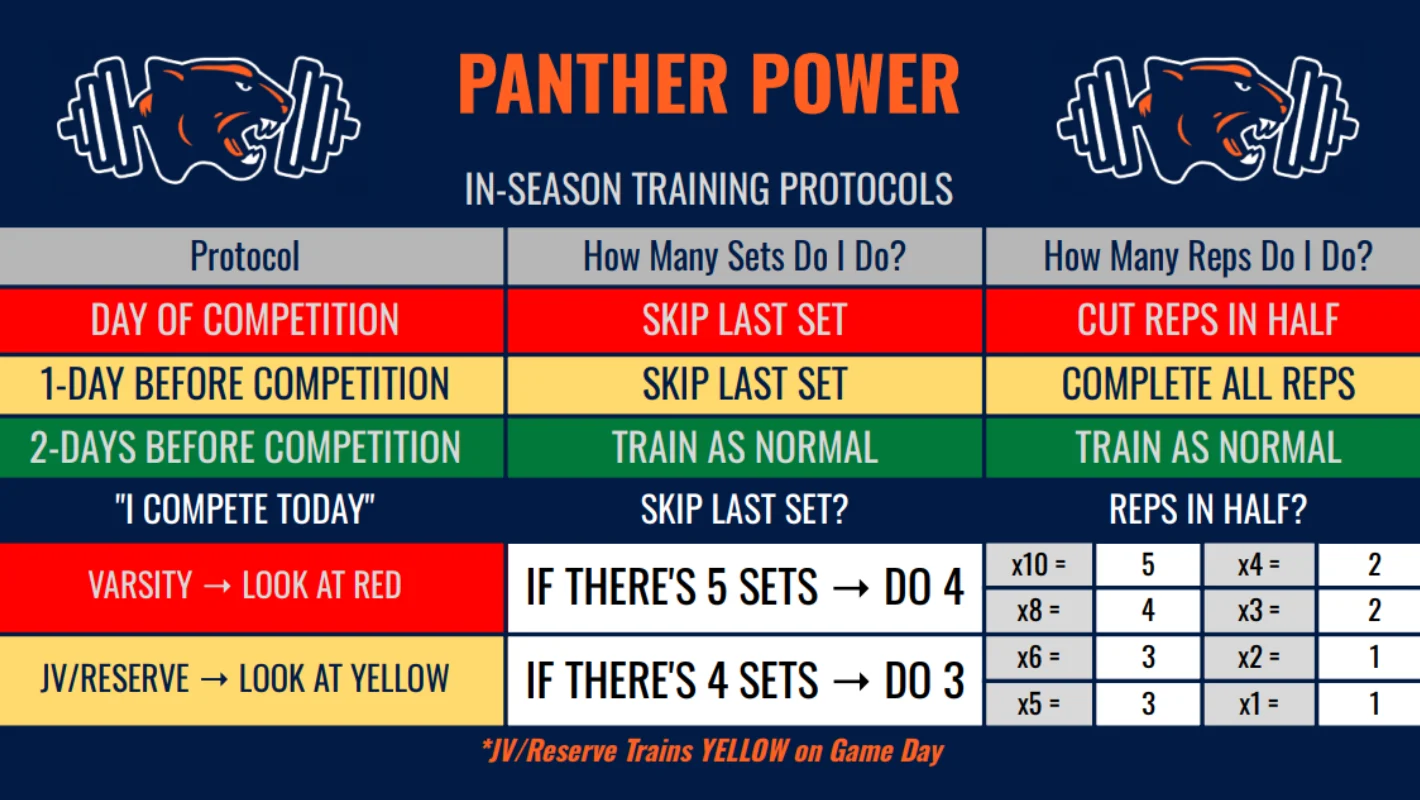
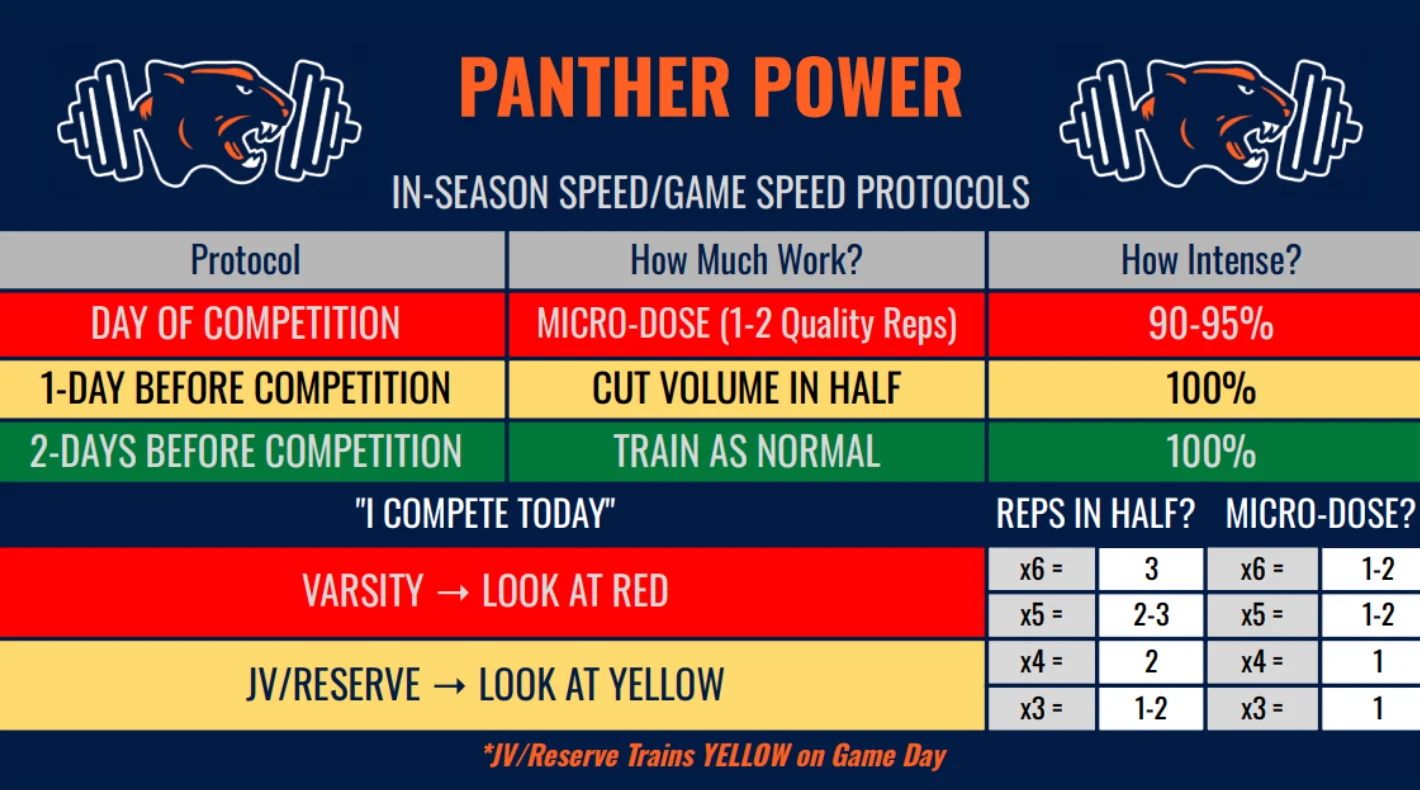
To manage this, we utilize the Cody Hughes Stoplight System. This is our primary tool for in-season load management, ensuring our athletes are peaking for Friday nights rather than leaving their best performances on the weight room floor. However, the system isn’t just about “taking it easy”; it’s about meeting the athlete where they are and teaching them how to train when they aren’t at their best.
Green Light (90–100% Readiness)
When the data lines up (high wellness scores, low academic stress, and jump metrics at or above baseline) we go. This is where we push the envelope and chase PRs. In-season, these days are precious. We use them to “stack wins” and maintain the high-end force production that usually falls off during a long season.
Yellow Light (70–80% Readiness)
This is the most critical part of the system. Most of a season is spent in the “Yellow.” The athlete is “feeling it.” Maybe they’re a little banged up or sleep-deprived from a mid-week away game. We don’t scrap the lift just because a kid is tired. Instead, we auto-regulate. We might keep the same movements but drop the volume by 20–30%, or use Cody Hughes’s VBT thresholds to cap the intensity. If the bar speed isn’t there, we don’t add weight. We’re still getting the work in and building resilience, but we’re doing it without digging a recovery hole they can’t climb out of before game day.
Red Light (<70% Readiness)
A “Red Light” day is a red flag for a potential soft-tissue injury. If an athlete’s CNS metrics are tanking and they’re mentally fried, pushing a heavy squat is just irresponsible. As a Director, you have to be the “Safety Valve” and save the athlete from themselves. On these days, we pivot. We swap the heavy load for mobility work, technical “rehab” drills, or active recovery. The pivot keeps athletes in the environment and keeps the “habit” of training alive, but it prioritizes their availability for the sport. At the end of the day, the best ability is availability.
3. Load Management: Being the “Safety Valve”
The Director is the only person who sees the “Total Load.” The head football coach only cares about football; the basketball coach only cares about basketball. But the athlete only has one nervous system.
By playing the sport scientist role, I can look at the data and tell a coach, “Hey, we’ve hit three days of high-CNS output in a row. If we push a heavy conditioning session today, we are begging for a soft-tissue injury.” That is the value of the role. We move from “guessing” how hard the kids are working to “knowing” exactly what they have left in the tank.
Why This Role Changes Everything
A Director of Athletic Performance transforms a school’s entire approach to student-athlete development by creating:
- Unified Leadership: One cohesive vision connecting PE, athletics, and offseason training.
- Consistent Standards: Shared movement language, clear technical benchmarks, and measurable performance goals.
- Improved Safety: Coordinated training loads and qualified instruction that reduce injury risk.
- Accountability: Transparent tracking of performance data and progression metrics for every athlete.
- Sustainability: A system that endures beyond individual personalities or coaching changes.
Most importantly, this role shapes culture. Athletes stop asking, “What do we have to do today?” and start asking, “What are we building?”
That shift transforms buy-in. That shift strengthens identity. And it drives measurable outcomes.
The Logistics of Alignment
A Director’s role is really to keep everything in sync so we’re not redlining our athletes. It’s about controlling the environment: aligning the training calendar, managing the flow of athletes, and making sure the stress being applied actually matches what the kid can handle.
We run a high-density model that’s designed to get the most out of our space and the athletes’ capacity to handle and adapt to the work.
- 11th/12th Grade: M/W/F are dedicated to the racks for true strength sessions. Tuesday is reserved for linear speed (top-end mechanics and max velocity). Thursday is game speed: change of direction, reaction, and sport-specific movement.
- 9th/10th Grade: These athletes lift during their PE class on Tuesday and Thursday, giving them structured exposure to strength training without overloading their schedule.
By separating lifting days (upperclassmen on M/W/F and underclassmen on T/Th) we avoid turning the weight room into a free-for-all. The separation keeps the space organized, reduces chaos, and gives us more “coaching eye” time where it actually matters. Equipment lasts longer, sessions are cleaner, and athletes get more individual attention.
At the core of it, this is about managing total stress. Training stress, school stress, life stress—it all adds up. When that’s controlled and coordinated, athletes can actually adapt instead of just surviving.
And when the Director handles the logistics and programming alignment, the sport coaches can stay locked in on what they do best (coaching the X’s and O’s) without worrying about whether the training load actually makes sense.
The Administrative Perspective
For athletic directors and school leaders, unified athletic performance leadership delivers clear value:
- Defined Ownership and Accountability: One role oversees the entire athlete development system, ensuring clarity in responsibilities and outcomes.
- Reduced Liability: Structured oversight, consistent standards, and qualified instruction mitigate risk and enhance safety.
- Measurable Return on Investment: Performance data, progression tracking, and structured programming demonstrate tangible outcomes.
- Scalable Systems: Programs can be implemented consistently across multiple teams and grade levels, creating a cohesive approach.
- Equity in Access: Every student-athlete—not just select teams—receives consistent, high-quality training.
Facilities, effort, and technology all contribute, but leadership is the true driver. Leadership transforms programs, culture, and results.
The Missing Link
High schools do not lack motivated athletes. They do not lack dedicated coaches. They do not lack equipment. What they lack is alignment. Without unified leadership, even the best programs operate in isolation. Development becomes personality-driven. Safety becomes reactive. Progress becomes inconsistent.
When athletic performance is structured under clear, centralized leadership:
- Standards become consistent.
- Progress becomes measurable.
- Safety becomes proactive.
- Culture becomes intentional.
- Development becomes predictable.
The difference between a busy weight room and a high-performing athletic department is not the equipment inside it. It is the leadership guiding it. The missing link in high school strength and conditioning isn’t more workouts. It’s the ownership of the system. And when someone owns the system, the system works: for every athlete, every season, every year.
References and Recommended Reading
- Dechant, Z. (2018). Movement Over Maxes. (Primary source for prioritizing technical movement over external load in youth athletes).
- Dietz, C., & Peterson, B. (2012). Triphasic Training. (Framework for eccentric and isometric loading in the 11th/12th-grade blocks).
- Gordon, J. (2007). The Energy Bus. (Foundational text for the cultural and leadership responsibilities of the Director role).
- Holler, T. (2017). Feed the Cats. (The philosophical driver for prioritizing speed and CNS recovery in high school athletes).
- Hughes, C. (2019). The Stoplight System for Athlete Readiness. https://x.com/clh_strength/status/1430658368671305736?s=20
- Jovanovic, M., & Flanagan, E. P. (2014). Researched Applications of Velocity Based Training. Journal of Australian Strength and Conditioning. (Supports the use of VBT for senior-level athletes).
- Lloyd, R. S., & Oliver, J. L. (2012). The Youth Physical Development Model: A New Framework for Long-term Athletic Development. Strength & Conditioning Journal. (The gold-standard citation for 9–12 LTAD models).
- Mann, B. (2011). The APRE Manual. (The blueprint for using autoregulation to handle the academic and athletic stress of high schoolers).
- Myer, G. D., et al. (2011). The Effects of Specialized Neuromuscular Training on Fueling the Next Generation of Athletes. American Journal of Sports Medicine. (Evidence for reduced injury rates in unified performance programs).
- Simmons, L. (2021). The Westside Barbell Book of Methods. (Influence for the Conjugate-style movement rotation to prevent stagnation).
- Mann, B. (2016). Developing Explosive Athletes: Use of Velocity-Based Training in Athletes. (Evidence and research on velocity-based training for athletes).
- Meadors,[ ](https://www.nsca.com/education/articles/practical-application-for-long-term-athletic-development/)L. (2012, May). Practical application for long-term athletic development. NSCA Education Articles. (Making LTAD simple for all grade levels in physical education).

