

Identity-First Team Performance: Applied Lessons from Mixed Martial Arts

In this Article
- Introduction: Identity and Cohesion Under Competitive Pressure
- Defining the Identity-First Framework
- Identity, Standards, and Team Alignment
- MMA as an Applied Model for Team Sports
- Applied Evaluation Criteria
- Comparative Case Analysis: Fighter A and Fighter B
- Comparative Patterns Among Elite UFC Lightweight Fighters
- Translating Identity to Team Sport Roles
- Coaching Implementation and Athlete Evaluation
- Monitoring Identity Development Through Technology
- Addressing a Common Debate: The “Well-Rounded” Misconception
- Conclusion: Identity as a Competitive Advantage

Summary
While mixed martial arts (MMA) is an individual competition, the sport offers a valuable applied framework for understanding team alignment through its emphasis on identity-driven strategy. By organizing preparation around primary strengths and using secondary skills for support, coaches can transform training from generalized skill accumulation into purpose-driven performance development. This approach simplifies decision-making under…
Introduction: Identity and Cohesion Under Competitive Pressure
Instructing a team to operate as a cohesive unit in competition remains one of the greatest challenges in sport coaching. While mixed martial arts (MMA) is an individual competition, the sport offers a valuable applied framework for understanding team alignment through its emphasis on identity-driven strategy. Successful fighters organize preparation and execution around primary strengths while developing secondary techniques that support, protect, and extend those strengths. This structure promotes both performance identity and situational awareness, allowing athletes to recognize limitations and mitigate them effectively.
An identity-first approach provides performers with a stable reference point during adversity, enabling disciplined execution rather than reactive decision-making. When applied correctly, this model transforms preparation from generalized skill accumulation into purpose-driven performance development. This increases competitive consistency and elevates teams from participation to contention.
This article examines the importance of an identity-first system and provides applied guidance for implementing this approach within a team sport setting. It presents an applied coaching framework informed by practitioner experience and comparative case analysis rather than experimental validation. Note that the author has removed or altered several identifying details to preserve anonymity. These cases serve as applied coaching examples rather than experimental findings.
Defining the Identity-First Framework
An identity-first system is a calculated style of training, strategy, and decision-making centered around an athlete’s or team’s primary strengths. Rather than attempting to equalize all skill areas, this approach emphasizes role clarity, alignment, and functional adaptability for sport.
Research in performance psychology suggests that clearly defined roles reduce cognitive load, enhance confidence, and improve execution in dynamic environments. Specifically, research on team performance demonstrates that clearly defined roles reduce ambiguity, improve confidence, and enhance task execution in interdependent sport environments (Beauchamp & Bray, 2001).
Within this framework, the coach and athlete do not ignore weaknesses but address them relative to how they support or undermine the athlete’s core identity. This perspective contrasts with fighting models that prioritize technical balance at the expense of clarity and cohesion. In high-pressure sport contexts, athletes rarely have the time or cognitive capacity to access their full skill set. Identity-first systems provide a simplified decision structure, allowing performers to default to strengths while selectively deploying complementary skills throughout the contest. From a cognitive perspective, reducing decision complexity under pressure improves execution efficiency by limiting extraneous cognitive load (Sweller, 1988). This model is particularly relevant for coaches seeking consistency, accountability, and efficient skill transfer across competitive settings.
Identity, Standards, and Team Alignment
As Nick Saban stated in an interview:
“I don’t think it’s about who you play; I think it’s about who you are. We create a standard for how we want to do things, and everybody’s got to buy into that standard, or you really can’t have any team chemistry.” (Saban, 2013)
This philosophy aligns directly with an identity-first approach, in which shared standards and clearly defined roles serve as the foundation for cohesive execution and adaptive performance. When a team operates together as a unit, everyone understands the assignment. Disorganization among players during game play leads to confusion and defeat. Once the team establishes an identity, they use their strengths for execution. They also implement secondary actions to support primary performance.

Image 1: World Champion fighter and coach Mike Brown demonstrating setting up takedowns to apply wrestling identity in performance.
MMA as an Applied Model for Team Sports
Although MMA is a single-athlete competition, the sport offers coaches and athletes from other sports a tremendous opportunity to dissect how to make a system work in unison. Coaches commonly conceptualize MMA training around three primary skill domains: striking, wrestling (takedowns and takedown defense), and grappling (ground-fighting/submission skills). This parallels American football, with its offense, defense, and special teams. The most successful fighters are great at one skill and good at the others. However, elite fighters use the other skills to supplement their strength and defend their weaknesses.
This article focuses on two case studies, labeled “Fighter A” and “Fighter B,” to illustrate and examine the proposed theoretical framework in MMA.
Applied Evaluation Criteria
The scoring rubric utilizes a five-point ordinal scale (1–5) to evaluate performance variables. We use opponent winning percentage as a proxy measure for strength of schedule, reflecting the competitive caliber of opposition. Win–loss data were obtained from Tapology (https://www.tapology.com), a publicly available mixed martial arts records database.
|
Subject |
Striking |
Wrestling |
Grappling |
Avg. score |
Win % |
Opp. Win % |
|
Fighter A |
4 |
3 |
4 |
3.7 |
57% |
59% |
|
Fighter B |
2 |
4 |
3 |
3 |
69% |
70% |
Comparative Case Analysis: Fighter A and Fighter B
The comparative analysis demonstrates that Fighter A received higher evaluations in individual technical competencies across two of three skill domains. However, career winning percentages indicate that isolated technical advantages do not consistently translate into competitive success. Despite lower evaluations in most areas except wrestling, Fighter B achieved greater long-term success against a stronger strength of schedule. These outcomes suggest that competitive effectiveness relies more on role identity, tactical alignment, and game planning than technical superiority. Performance success links to structuring strategies around a primary competitive identity, supported by complementary skills and situational decision-making.
Fighter A demonstrated competency across multiple skill domains but lacked a coherent execution plan. In combat sports, this diffuse approach often results in athletes distributing effort too broadly, preventing mastery or reliable performance under pressure. In contrast, Fighter B operated from a clear wrestling-based identity. Although striking proficiency lagged, the athlete developed it deliberately to support wrestling entries and competitive control. This role-defined strategy reduced the margin for error by protecting weaknesses while reinforcing the athlete’s primary competitive advantage.
Comparative Patterns Among Elite UFC Lightweight Fighters
The table below displays the top-ranked fighters in the UFC Lightweight division as determined by the organization’s official rankings. The numbers display a pattern of clearly defined primary strength rather than equal proficiency across all skill areas. The listed fighters consistently display one dominant discipline: striking, wrestling, or grappling. They train secondary skills to support that identity within a specific game plan. Strong career winning percentages despite uneven skill profiles reinforce that performance success comes from role clarity and strategic alignment, not generalized balance. For coaches, this underscores the importance of designing training around what athletes do best, then layering complementary skills. The same principle applies in team sports, where units and players perform best when roles and systems reflect a clear performance identity.
|
Subject |
Ranking |
Striking |
Wrestling |
Grappling |
Avg. Score |
Win % |
|
Arman Tsarukyan |
1 |
3 |
5 |
4 |
4 |
89% |
|
Charles Oliveira |
2 |
4 |
2 |
5 |
3.7 |
77% |
|
Max Holloway |
3 |
5 |
2 |
3 |
3.3 |
77% |
|
Justin Gaethje |
4 |
5 |
3 |
2 |
3.3 |
84% |
|
Paddy Pimblett |
5 |
4 |
3 |
4 |
3.7 |
89% |
|
Dan Hooker |
6 |
4 |
3 |
3 |
3.3 |
65% |
|
Mateusz Gamrot |
7 |
3 |
5 |
4 |
4 |
86% |
|
Benoît Saint Denis |
8 |
4 |
3 |
4 |
3.7 |
84% |
|
Rafael Fiziev |
9 |
5 |
3 |
2 |
3.3 |
77% |
|
Renato Moicano |
10 |
3 |
3 |
5 |
3.7 |
71% |
Translating Identity to Team Sport Roles
This principle translates directly into team sports through consistent awareness of individual assignments. When athletes understand their specific responsibilities regardless of position, role, or depth-chart status, their decision-making simplifies. This clarity allows players to allocate effort precisely where it is required, reducing distraction and inconsistency. When coaches clearly and consistently communicate role expectations, athletes are better able to play freely within the structure of the system.
What happens when identity isn’t working? When an opponent neutralizes an athlete’s primary competitive identity, adaptability becomes essential. In sport, performance rarely unfolds exactly as designed, requiring real-time adjustment. Mixed martial artists demonstrate this capacity at a high level, as opponents may overcommit to defending primary attacks. Effective performers respond by switching to secondary (supplemental) actions to maintain the advantage. Developing these secondary options is critical, as they preserve role integrity while enabling success under competitive pressure. This is where complementary techniques take precedence to gain an advantage.
Fighter B found themselves in this situation in several bouts. Opponents were aware of their wrestling base, leading them to focus heavily on takedown defense. When fighters spend an exorbitant amount of energy on their opponent’s identity, they may neglect other areas of attack. Once Fighter B recognized this, they adjusted. Adjusting from wrestling to striking led to success, and they even ended fights with a knockout.
Winning with supplemental strategies appears across team sports. In American football, a run-dominant offense often creates passing opportunities when defenses overcommit to stopping the rush. In basketball, teams that emphasize interior scoring must have an answer for perimeter shooting when they cannot breach the paint. In baseball, power-oriented lineups may need to shift toward contact-focused at-bats against elite pitching. Mixed martial artists routinely make comparable adjustments through secondary attacks, often within seconds. Other sports can learn from the speed and efficiency with which athletes execute these adaptive decisions.
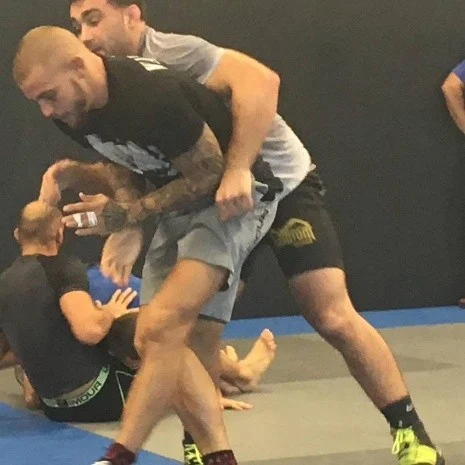
Image 2: Dustin Poirier, notably a striker, training wrestling escape techniques to strengthen the chance of keeping the fight standing where he can box. A clear example of training secondary areas to supplement primary attacks.
Coaching Implementation and Athlete Evaluation
Implementing an identity-first system begins with acute observation of athlete strengths in performance contexts. Athletes may lack confidence in specific skills or display overconfidence in areas where they are technically deficient. The coach is responsible for identifying these discrepancies and communicating role-defining feedback that positions the athlete for success. Because athletes differ mentally, this process depends heavily on the quality of the relationship the coach has structured with their players.
Mixed martial arts heavily utilizes situational training to isolate and evaluate specific settings of the sport that coaches may otherwise overlook. By placing athletes in controlled, uncomfortable scenarios, coaches can assess whether a skill functions as a strength, a supplemental tool, or a liability. These environments often reveal latent capabilities and recalibrate confidence in underused techniques. Situational training also clarifies whether frequently used skills meaningfully support an athlete’s identity at the volume applied. When implemented effectively, this approach answers critical performance questions and can benefit athletes across sports.
Monitoring Identity Development Through Technology
While observational coaching and situational training provide essential qualitative insight, technology serves as a verification tool. It ensures that physical capacities supporting identity remain intact throughout training and allows coaches to monitor objectively. For example, in a wrestling-heavy identity where proper penetration relies on explosiveness and loading technique for takedown entries, power becomes a non-negotiable performance variable.
Coaches may use Velocity Based Training (VBT) systems to monitor bar speed during loaded squats or trap-bar deadlifts. Fatigue may manifest as a decline in mean or peak velocity at prescribed loads, which could be a symptom of improper training or overtraining. Similarly, coaches can use specific plyometric exercises, such as jump testing, weekly to track neuromuscular readiness. Reductions in jump height or power output may signal diminished explosive capacity.
If a fighter’s identity depends on rapid entries and drive through contact, maintaining these metrics becomes necessary. The same principle applies in all sports, as well as varying identities in MMA. A run-dominant football identity might track force output and sprint acceleration metrics for primary personnel. In baseball, a hitter whose identity centers on rotational power could use sensors for bat speed and force plate data to ensure proper hip-torque development remains aligned with their strength. A striker in MMA might monitor their reactive strength index or hand-speed metrics to verify that crisp striking supports their strategy.
Objective monitoring does not replace identity; it protects it. By identifying key details that support primary strengths, coaches can ensure supplemental training does not dilute primary game planning. When properly integrated, performance technology reinforces clarity rather than promoting generalization in development. In this way, data collection becomes identity-specific rather than identity-neutral.
The identity-first framework prioritizes primary strengths while deliberately addressing weaknesses through their impact on performance. This approach does not ignore deficiencies; rather, it identifies liabilities by evaluating whether skills support or undermine an athlete’s competitive identity. Fighter A displayed broad technical competence but failed to integrate these skills into a unified strength. In contrast, Fighter B acknowledged striking limitations and developed the skill strategically to reinforce a wrestling-based approach. All athletes and teams possess inherent gaps, but when coaches narrow the margin for error through identity-aligned adjustments, competitive outcomes improve.

[Image 3: Ryan Quinn coaching his fighters through situational awareness with wrestling on the cage, submission defense, and specific ground and pound techniques]
Addressing a Common Debate: The “Well-Rounded” Misconception
A frequent debate regarding this approach is whether athletes should pursue broad, evenly distributed skill development rather than centering performance around a primary identity. Advocates of the “well-rounded” model argue that achieving high competency across all performance domains allows greater adaptability, reduces predictability, and equips athletes to handle a wider range of competitive scenarios. While this perspective has natural appeal, it does not align with how high-pressure performance environments function.
Even among elite mixed martial artists often labeled as “well-rounded,” fighters still seek victory through strategy favored around the strengths they possess. They do not develop secondary skills to replace those strengths but to support and enhance them. A fighter recognized for balanced striking, wrestling, and grappling still works from a dominant base within those skill sets. This may be range control, defensive wrestling, pressure, or counter-striking, while other skills serve as supplemental tools protecting that foundation. The coherence of this identity, not the distribution of skill ratings, determines reliability in competition.
Team sport athletes face similar cognitive and situational restrictions. When performers attempt to access a broad skill set during competition, analysis paralysis may occur. In contrast, identity-first systems simplify competitive choices by directing athletes toward their strengths while enabling an adaptive response through trained secondary actions. This approach does not limit development; rather, it organizes development so that growth in supplemental areas is reinforced rather than diluting the athlete’s core competitive strategy.
Conclusion: Identity as a Competitive Advantage
An identity-first system provides coaches with a practical framework for aligning strategy, roles, and execution under competitive pressure. The comparative cases presented demonstrate that success depends less on broad technical proficiency and more on clarity of purpose, role-defined game planning, and the strategic use of supplemental skills. By centering the game plan around primary strengths, athletes gain a reliable reference point during adversity, while secondary actions allow for adaptive responses without losing identity.
For coaches, this approach simplifies decision-making, sharpens player development, and narrows the margin for error imminent in competition. When applied consistently through observation, communication, and situational training, an identity-first model can elevate teams from functional participation to sustained contention.
Citations
Beauchamp, M. R., & Bray, S. R. (2001). Role ambiguity and role conflict within interdependent teams. Small Group Research, 32(2), 133–157. https://doi.org/10.1177/104649640103200202
Sweller, J. (1988). Cognitive load during problem solving: Effects on learning. Cognitive Science, 12(2), 257–285. https://doi.org/10.1207/s15516709cog1202_4
Saban, N. (2013). Interview by S. Kroft. 60 Minutes [Television broadcast]. CBS News.
Tapology. (n.d.). MMA fighter records and statistics. https://www.tapology.com
Creswell, J. W., & Poth, C. N. (2018). Qualitative inquiry and research design: Choosing among five approaches (4th ed.). SAGE Publications.
Ultimate Fighting Championship. (n.d.). UFC rankings: Lightweight division. https://www.ufc.com/rankings

